

For years, choosing a QA vendor meant comparing proposals, reviewing case studies, and sitting through capability calls. The most important question still remains unanswered: how will this vendor perform inside your product when the release risk is real?
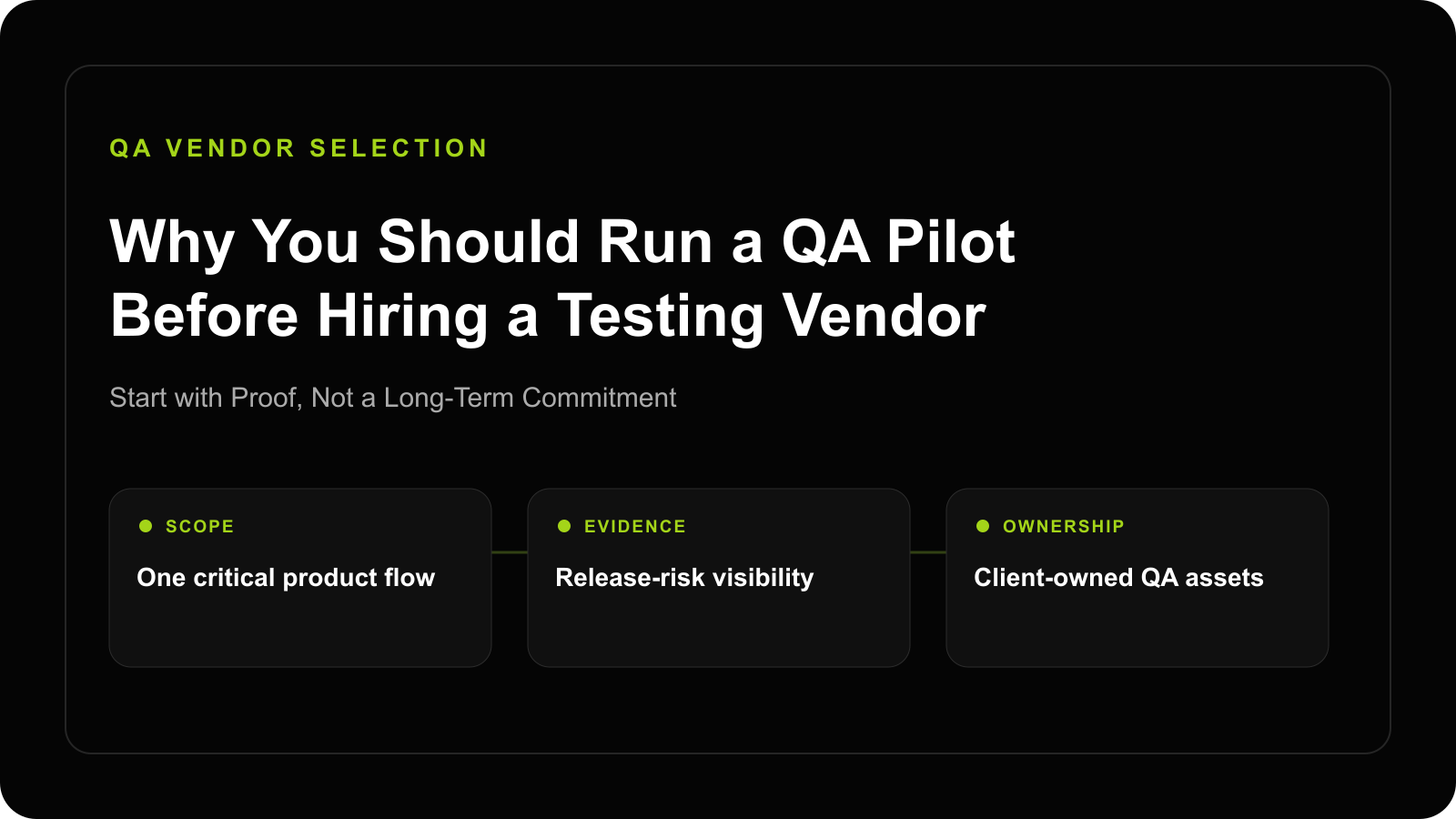
Instead of asking the vendor to describe its approach, you give it one critical product flow and evaluate how it understands risk, builds coverage, works with engineers, and creates QA assets your team can keep.
This post explains what a QA pilot should deliver, which mistakes can make its results misleading, and how to use real evidence to evaluate a testing vendor before signing a long-term contract.
30-Second Summary
What is a QA pilot, what should it prove, and why should you run one before choosing a testing vendor?
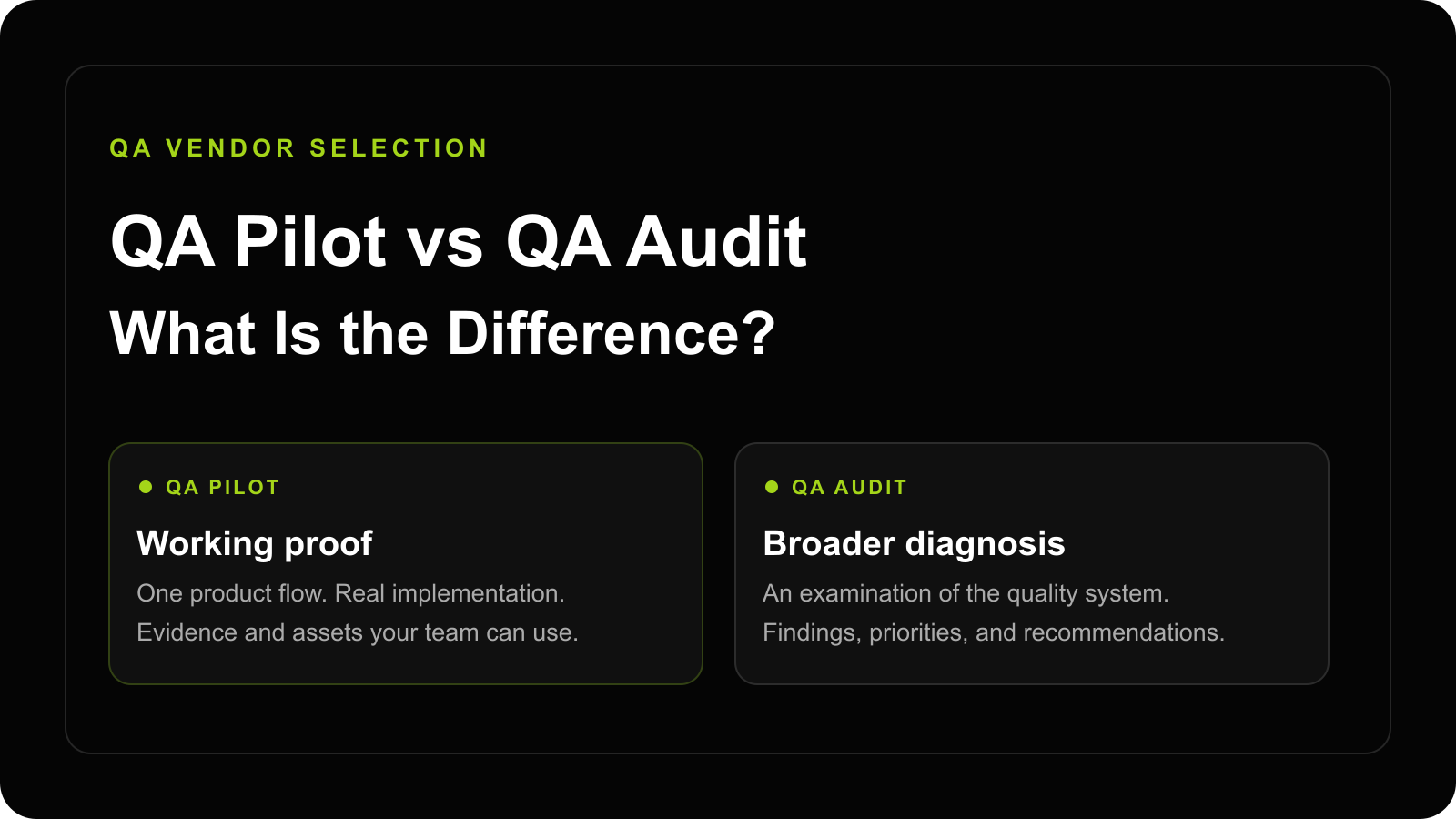
- A QA pilot is a real implementation, not an audit or sales demo. The vendor works inside one critical product flow and delivers practical QA assets.
- It reduces product risk, the pilot identifies coverage gaps in areas such as onboarding, checkout, payments, APIs and integrations, or data pipelines.
- It reduces commercial risk, you can evaluate how the vendor performs inside your product before signing a long-term contract.
- Success is measured through outcomes, not activity, look for useful coverage, maintainable automation, CI/CD readiness, and clearer release-risk visibility, not just more bugs or test cases.
- AI-Augmented QA supports the work but does not replace human judgment, experienced QA engineers must validate the output and prioritize risks.
- The client keeps the assets. Tests, automation, configurations, and documentation remain with the product team, without vendor lock-in.
Key point: A proposal tells you what a QA vendor promises. A pilot shows you how it actually works. Before trusting a vendor with your releases, let it prove that it can build the QA system behind confident releases.
What Is a QA Pilot?
A QA pilot is a focused engagement that applies a real testing approach to one critical product flow, turning its most important risks into targeted improvements and usable, client-owned QA assets while providing clear evidence of what works, what remains exposed, and what should happen next.
It starts with a defined product flow, clear risks, agreed success criteria, and a limited delivery period. The QA team evaluates the existing coverage, tests the selected area, implements the highest-value improvements, and documents the risks that still need attention.
The value of a pilot is not how much testing fits into a short period, it is the clarity it creates. By the end, the company should understand its most important risks, what should be automated next, and whether the proposed QA approach fits its product and development workflow.
What Teams May Misunderstand About QA Pilots
A QA pilot is easy to make look impressive: a vendor can fill the board with defects, create dozens of test cases, and automate a visible flow within days. But these outputs answer the wrong question unless they show that the vendor can understand real product risk, make sound decisions, and build QA capability the team can trust after the pilot ends.
Turning it into a bug hunt.
Teams may assume that the vendor finding the most bugs has delivered the best pilot, but a long defect list can be filled with minor issues. The stronger signal is whether the vendor identifies the failures that could affect customers, revenue, operations, or release decisions, and builds coverage to prevent them from returning.
Choosing an easy feature.
Some teams select a simple, isolated screen because it feels safer and easier to complete, that may produce a smooth demonstration, but it reveals little about the vendor’s ability to handle APIs, integrations, permissions, test data, or failure recovery. A pilot should be controlled, but the challenge must still be meaningful.
Measuring volume instead of value.
A pilot can generate dozens of test cases, scripts, and defect reports while still failing to protect the scenarios that matter most. The better measure is whether the resulting coverage is relevant, maintainable, and strong enough to support future release decisions.
Removing product context.
Limiting information may seem like a good way to test whether the vendor can understand the product independently. In practice, it turns the pilot into a guessing exercise, where the team tests what is easiest to see instead of what would be most costly to miss. Teams sometimes believe that a capable vendor should prove itself with minimal support but in reality, meaningful testing depends on customer journeys, business rules, past incidents, technical constraints, and release priorities. Without that context, the vendor may test what is visible rather than what is important.
Expecting too much from a short pilot.
A pilot is not a compressed transformation of the entire QA function, it should prove the approach inside one defined area, expose important risks, and show what should happen next. It becomes less useful when teams expect it to answer every quality question at once. Expanding the scope too far creates shallow results and makes the vendor harder to evaluate.
Ignoring ownership.
Some teams treat the resulting tests and automation as temporary work that only matters if the contract continues, that defeats part of the pilot’s purpose that should not produce disposable work or assets that only function while the vendor is involved. Regardless of the final vendor decision, the client should leave with tests, automation, configurations, and documentation it can understand, run, and extend independently.
A strong pilot is not measured by how busy the vendor looks or how many deliverables appear in the final report. It should leave the team with clear evidence of the vendor’s judgment, technical ability, working style, and capacity to reduce release risk, enough to decide with confidence whether the partnership should continue and scale.
How a QA Pilot Works?
A well-structured QA pilot creates evidence at every stage. Without one, important decisions are often based on proposals, assumptions, and capabilities that have not been tested inside the actual product.
| Stage of the QA pilot | What the pilot should do | What can happen without a pilot |
|---|---|---|
| Select one critical product flow | Focus the work on an area connected to customer, revenue, or operational risk | The vendor may be evaluated through broad claims rather than a meaningful product challenge |
| Define risks and success criteria | Establish the scope, priorities, expected outcomes, and measures of success | Expectations can remain unclear, making the vendor difficult to evaluate objectively |
| Review the current QA state | Identify existing coverage, known defects, release blockers, and workflow limitations | Important gaps may remain hidden, while existing work is duplicated or ignored |
| Test and improve the selected flow | Demonstrate risk-based testing, product understanding, and practical problem solving | The vendor’s ability to work inside the real product remains unproven |
| Build the first automation layer | Create maintainable tests prepared for regression and CI/CD execution | Automation may be discussed during sales calls but tested only after a larger commitment |
| Review results and transfer ownership | Make remaining risks visible and hand over usable tests, documentation, and automation | The client may enter a contract without clear evidence, asset ownership, or an exit path |
A pilot turns vendor selection from a promise-based decision into an evidence-based one, giving the team a practical view of how the vendor understands risk, works inside the product, and delivers under real conditions before a long-term commitment is made.
Benefits of a QA Pilot
Every QA pilot produces results but not every result deserves the same level of trust. To evaluate one properly, teams must separate immediate gains from hidden risks and from questions that can only be answered over time.
Real proof before commitment.
A pilot shows how the vendor understands the product, prioritizes risk, collaborates with engineers, and handles technical constraints. These are capabilities that proposals and sales demonstrations cannot fully prove.
Earlier visibility into release risk.
Working inside a critical flow can expose missing coverage, fragile integrations, unclear business rules, and release blockers before they create larger problems.
Reusable assets instead of temporary activity.
Tests, automation, configurations, and documentation should continue creating value after the pilot. Client ownership also makes it easier to continue internally or with another partner.
A narrow scope can create false confidence.
An isolated or unusually stable feature may not represent the complexity of the wider product. The selected flow should be controlled enough to complete, but realistic enough to test meaningful dependencies and risks.
Pilot theatre can reward the wrong outcomes.
A vendor may optimize for bug counts, test volume, or a polished final presentation. The evaluation should focus on coverage quality, maintainability, release visibility, and how well the work fits the existing development process.
AI can find test scenarios and draft automated tests faster, but it can also produce incorrect output, human validation is necessary before generated scenarios or scripts become part of the QA workflow.
At its best, a QA pilot delivers value twice: it strengthens a critical product flow today and gives the team the evidence to choose the right QA path tomorrow.
Setting the Right Expectations for a QA Pilot
Getting useful results from a QA pilot is one thing, knowing how far those results can be trusted is another. The strongest teams treat the pilot as the first piece of evidence in a larger decision not as a miniature version of an entire QA program.
Judge the results within the agreed scope.
A pilot focused on one critical flow can show how the vendor understands risk, builds coverage, and works with the product team. It should not be used to predict performance across every browser, integration, or product area.
Separate immediate quality from long-term fit.
The pilot can reveal automation quality and technical decisions, while questions about long-term maintenance, wider team performance, and large-scale delivery should be validated during the next phase.
Look beyond automation.
Automated tests bring speed and consistency, but they cannot cover every type of risk. A strong pilot also uses manual exploration, API checks, and business-context validation wherever human judgment adds more value.
Turn unanswered questions into next steps
Anything the pilot cannot evaluate should become part of a clear follow-up plan, with defined priorities for wider coverage, specialist testing, or longer-term validation.
The goal is not to prove everything in a short period. It is to replace broad assumptions with useful evidence, make the remaining risks visible, and define the smartest next step.