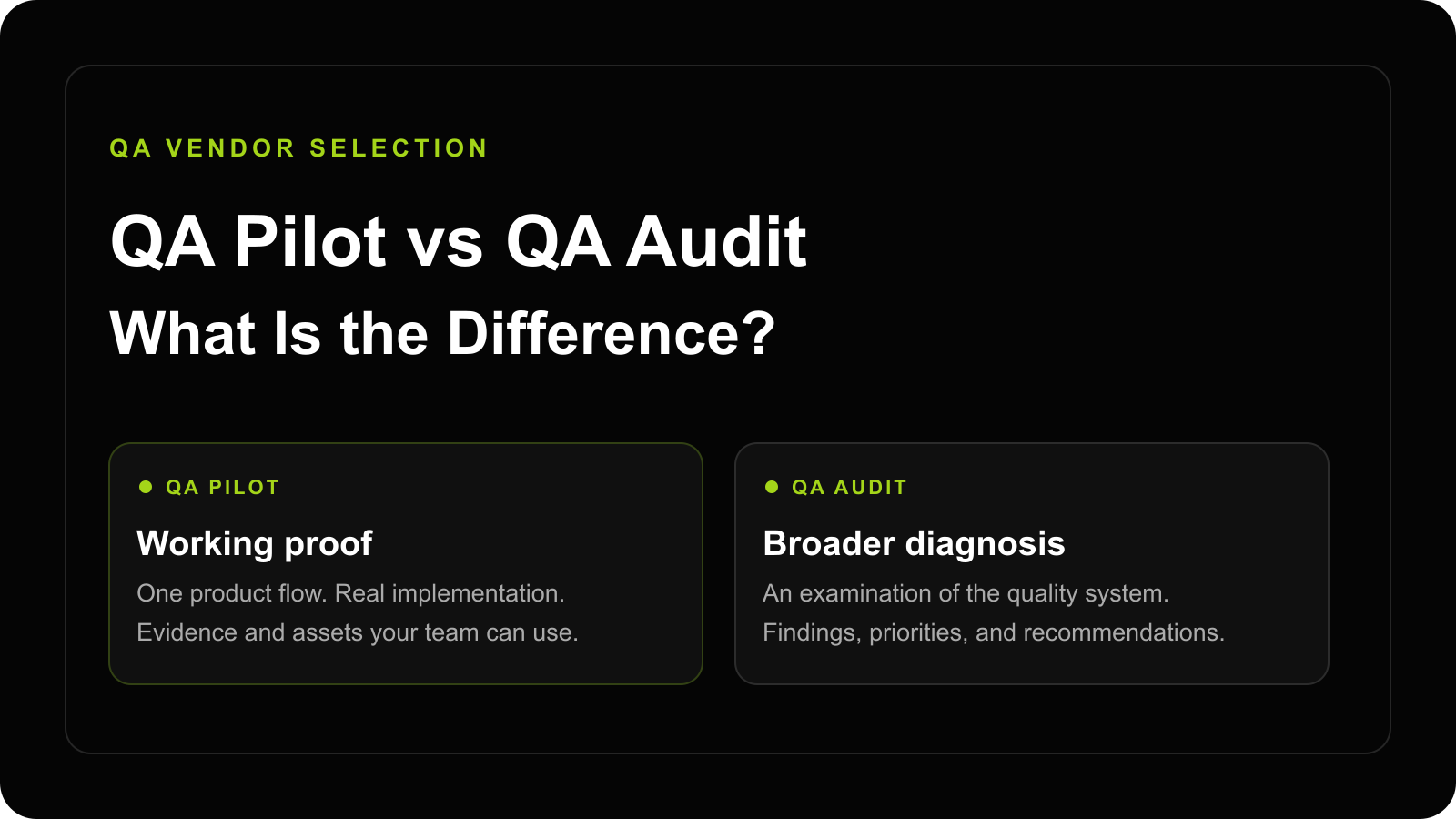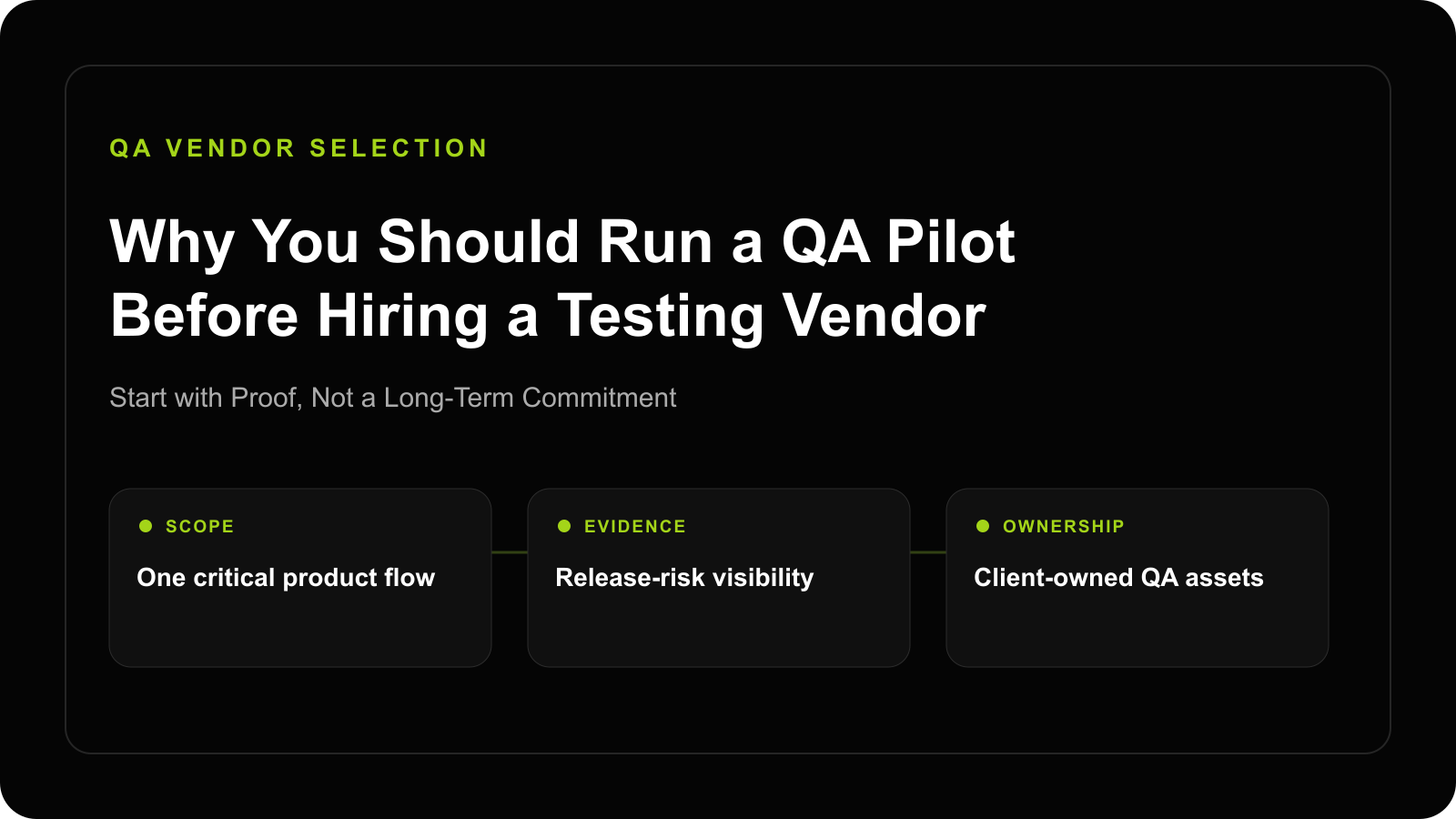


A feature can pass every planned test and still leave the team with one uncomfortable question: what have we missed? The answer is often hidden between a customer journey, an API response, a data dependency, or a business rule that nobody thought to challenge.
A 14-Day AI-Augmented QA Pilot is designed to make that uncertainty visible by following one critical product flow from context and risk through coverage, implementation, execution, and handover. AI may accelerate analysis and testing where appropriate, but experienced QA professionals review the output and remain accountable for the decisions.
This article explains what happens during those 14 days, what the team can realistically receive, what can limit the result, and what should remain useful after the pilot ends.
30-Second Summary
What should happen during a 14-Day AI-Augmented QA Pilot, what should it deliver, and what should your team be able to use on Day 15?
- Before the pilot begins, the client and QA team agree on one business-critical product flow, the main release problem, one success signal, a named owner, and the least-privilege access required for implementation.
- The first stage focuses on understanding the product context, mapping its actors and dependencies, identifying release risks, and turning those risks into prioritized test scenarios with clear expected outcomes.
- The QA team then implements and runs the improvements justified by the selected flow, which may include automated tests, API or integration checks, reusable test components, test data, or an approved AI-assisted workflow.
- Where the available access and infrastructure allow it, useful checks are stabilized and connected to the team’s existing CI/CD, reporting, or defect-triage processes so that their results can support future release decisions.
- AI-Augmented QA can accelerate context analysis, scenario design, test creation, failure investigation, and evidence preparation, but experienced QA professionals must review its output and remain responsible for coverage, implementation, and risk decisions.
- The final handover should explain what was tested, what remains untested, which risks and blockers are still open, what assets were created, how those assets should be used, and which next step would provide the most value.
- After the pilot ends, the client should retain the agreed coverage model, tests, configurations, execution evidence, implementation guidance, and supporting documentation created within the pilot’s scope.
Key point: A good QA pilot does not try to test the entire product in two weeks; it uses one critical flow to show whether the proposed QA model can create useful coverage, repeatable execution, and clearer release-risk visibility.
Why a 14-Day QA Pilot Should Follow Product Risk, Not a Template
The most common mistake is expecting every 14-Day AI-Augmented QA Pilot to deliver the same combination of tests, automation, and reports, even though a payment integration, an onboarding journey, and a data pipeline expose different risks and require different forms of coverage.
Teams may also judge the pilot mainly by its visible outputs, although an automated test provides limited value when it is based on unverified assumptions, avoids the most difficult parts of the flow, or cannot be maintained by the internal team.
Missing test data, unstable environments, unclear requirements, or limited access do not automatically make the pilot unsuccessful, because identifying these constraints and showing how they affect coverage can be as valuable as finding a defect. A strong pilot should therefore demonstrate what can be implemented under real product conditions while making unresolved risks and limitations equally visible.
What Actually Happens Inside the 14 Days
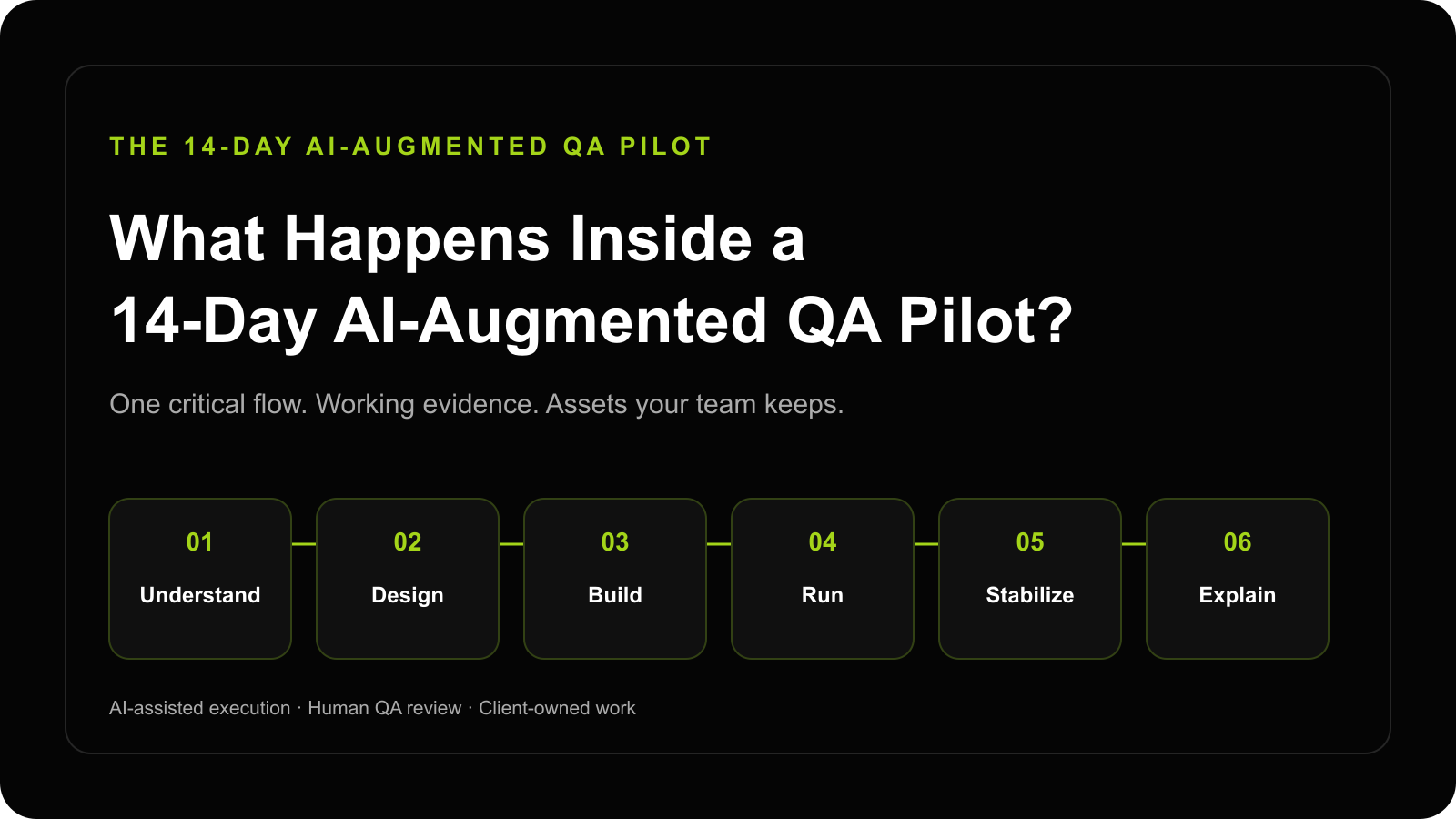
The pilot delivery model is not a sequence of isolated testing tasks planned in advance, because the evidence uncovered at each stage influences what the team investigates, implements, and validates next. AI may support approved activities throughout the process, but every material decision remains subject to human QA review.
- Understand the flow.
The team assembles the available product knowledge, traces the selected journey across its technical and business boundaries, and identifies missing information that could affect the work. - Design the coverage.
The most consequential failure modes are converted into focused scenarios, with the appropriate validation layer, personas, environments, and test data selected for each one. - Build the protection.
The team implements only the checks or controls that can create a useful and maintainable signal within the agreed scope and existing technology stack. - Run the checks.
Observed failures are reproduced and investigated before being classified, preventing test instability, environment problems, or incorrect data from being reported as product defects. - Stabilize the result.
Useful checks are hardened against avoidable fragility, while reliability constraints and maintenance requirements are documented instead of being hidden. - Explain the evidence.
The findings are brought together into a reviewable account of the work, allowing the product team to determine which QA action deserves priority after the pilot.
How Does a 14-Day AI-Augmented QA Pilot Create Evidence?
The sequence of a 14-Day AI-Augmented QA Pilot may adapt to the product’s complexity and available access, but the boundary remains fixed around one critical flow, one success signal, and a defined implementation period.
How the 14-Day QA Pilot Progresses
| Timing and stage | What happens inside the product | Main output or decision |
|---|---|---|
| Before Day 1 - Scope and access | The client and QA team agree on the critical flow, success signal, named owner, working environment, and least-privilege access before the delivery clock begins. | A confirmed scope and the practical conditions required to begin implementation without avoidable delays. |
| Days 1-2 - Understand | The team reviews product context, architecture, business rules, dependencies, existing quality signals, known incidents, and release constraints. | A reviewable context map, identified information gaps, and a risk boundary for the selected flow. |
| Days 3-4 - Design | Potential failures are prioritized, expected behavior is clarified, and the appropriate scenarios, validation layers, personas, environments, and test data are selected. | A risk-ranked coverage model and an agreed plan for the improvements that can create the most value within the remaining time. |
| Days 5-10 - Build and run | The team implements and executes the agreed checks or quality controls across the layers justified by the selected flow, with failures investigated before they are classified. | Working improvements and execution evidence showing what passed, failed, was blocked, or could not be verified. |
| Days 11-12 - Stabilize and integrate | Useful checks are hardened, avoidable instability is investigated, and evidence is connected to existing delivery, reporting, or triage workflows where feasible. | More reliable test signals, documented constraints, and practical guidance for running and maintaining the implemented work. |
| Days 13-14 - Explain and hand over | The team reviews the completed work, coverage boundaries, unresolved blockers, remaining risks, delivered assets, and responsibilities after the pilot. | A clear handover and an evidence-based decision about whether to stop, extend the current work, or expand the model into another critical flow. |
The objective is not simply to complete every stage within 14 days, but to ensure that each one leaves enough evidence for the next decision. If the pilot ends with a defect list but no connection between risk, coverage, implementation, and ownership, it has shown testing activity without proving the wider QA approach.
What the Team Owns After Day 14
Day 14 should mark the end of the pilot boundary, not the end of the client’s ability to use the work, which is why the agreed code, configurations, evidence, coverage assets, and runbooks created during the 14-Day AI-Augmented QA Pilot remain with the product team.
Ownership should also be practical rather than contractual only, meaning the internal team should know where the assets are stored, how to run and interpret them, what maintenance they require, and where their current limits begin. Pre-existing AQA materials and third-party components remain under their original terms, so the handover should distinguish clearly between what the client owns and what it is licensed to use.
What Can Limit the Result
A fixed timeframe creates focus, but it also makes product readiness important because access delays, unavailable test data, or unstable environments can change an item from something implemented and executed into something documented for later completion.
Unclear requirements can have a similar effect, although the right response is not to invent expected behavior but to record the assumption, identify who must resolve it, and show which part of the evidence remains inconclusive. Automation should not be forced either, because a frequently changing interface, an unreliable dependency, or a scenario that requires human exploration may produce more maintenance than release value.
The pilot also depends on timely participation from a product or engineering owner who can answer questions, review evidence, and make scope decisions, while the 14-day boundary means that unresolved dependencies may remain visible in the handover rather than being completed inside the engagement.
What Happens After Day 14
The end of the pilot is a decision point rather than an automatic renewal, and the team can choose the next step according to the evidence produced:
- Stop and operate internally.
Keeping the delivered assets and transferring their day-to-day ownership to the existing QA or engineering team. - Continue the selected work.
Adding the remaining high-value coverage or completing an integration that could not be finished within the original boundary. - Expand the model.
Applying the same approach to another critical product flow once the first implementation has proved useful. - Add targeted support.
Bringing in QA leadership or engineering capability around the existing team without transferring responsibility for the entire QA function. - Move to recurring delivery.
Using a managed QA model when ongoing execution, regression, maintenance, and release evidence require continuous ownership.
None of these options is assumed in advance, because any work after Day 14 should be a separate decision based on what the pilot revealed, what the team can operate independently, and which remaining risk deserves attention next.
Bottom Line
A good QA pilot should make one critical product flow easier to test, maintain, and release with confidence under real delivery conditions, while giving the product team enough evidence to judge whether the approach improved its ability to manage that flow and whether the result will remain useful after the pilot team steps away.