

- AI-Augmented QA
- Human QA judgment
- Release confidence
Ship one safer, faster product flow in 14 calendar days.
A senior AQA team works inside one agreed business-critical flow to expose release risk, implement the highest-leverage QA improvements, and leave your team with usable evidence and client-owned assets.
Pilot scope at a glance
Leave Day 14 with stronger protection and a clear next move.
- Duration
- 14 calendar days
- Scope
- One agreed business-critical product flow
- Outcome
- Working QA improvements backed by reviewable evidence
- Ownership
- AQA-created pilot assets stay with your team
Independent review profiles
Independent evidence, clearly linked to its source.
-
Client rating What clients valueView the profile
-
Client ratingView the Bucharest rankingTop 1 Software Testing Companies
Bucharest, Romania
-
Client ratingView the Bucharest rankingTop 1 Software Testing Companies
Bucharest, Romania
-
Client rating Published category scoresView the profile
- Budget
- 5.00
- Quality
- 5.00
- Schedule
- 5.00
- Communication
- 5.00
What changes
Turn release uncertainty into evidence your team can act on.
The pilot focuses on one critical flow so implementation and evidence arrive inside the same 14-day scope.
Today
Critical user journeys exist mostly in team memory.
Day 14
The agreed flow is mapped, risk-ranked, and connected to explicit test evidence.
Today
Coverage volume is visible, but business protection is unclear.
Day 14
Coverage priorities are tied to user, revenue, trust, and operational impact.
Today
Automation may be brittle, slow, or disconnected from release decisions.
Day 14
The highest-leverage checks are implemented or scoped with clear ownership and run guidance.
Today
AI use is informal, inconsistent, or difficult to review.
Day 14
AI-assisted work has approved context, human review, and source-linked evidence.
Today
Leadership lacks a clean basis for the next QA investment.
Day 14
Leaders receive a practical continue, extend, or stop recommendation grounded in observed work.
Connected delivery model
One connected delivery model.
Leadership. AI QA Enablement. Automation Engineering. Continuous QA Delivery.
Four capabilities, applied according to the agreed scope.
Risk, architecture, implementation, and evidence stay connected. Scope-dependent work is selected for leverage rather than forced into every pilot.
-
Risk and direction
QA Leadership
A QA Architect and QA Lead set the risk boundary, success signal, delivery priorities, and evidence standard.
Core Included in every pilot
-
Human-governed leverage
AI QA Enablement
Client-approved models can accelerate context analysis, scenario design, maintenance, and evidence preparation under human review.
Scoped Applied when justified by the agreed flow
-
Working protection
Automation Engineering
The team can implement or harden high-value API, browser, mobile, integration, or performance checks when the selected flow justifies them.
Scoped Applied when justified by the agreed flow
-
Delivery integration
Continuous QA Delivery
Useful checks can be connected to existing CI/CD, reporting, triage, and release decision paths within the access and time boundary.
Scoped Applied when justified by the agreed flow
Context to evidence
A human-governed workflow from product intent to release signal.
Each stage remains visible and reviewable. AI assists where approved; accountable people make scope, implementation, and release judgments.
-
Stage : 1
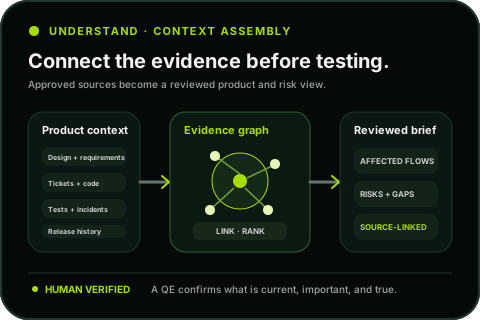
Understand
CoreFix the context first—or automate the wrong thing faster.
AQA maps the one critical flow against approved requirements, designs, tickets, repositories, existing tests, incidents, business rules, integrations, and release history. AI helps connect scattered evidence; accountable QA practitioners confirm what is current, what is missing, and what can actually hurt the release.
Managed activities
- Critical-flow context assembly
- Requirements, design, and architecture review
- Change and dependency impact analysis
- Known-risk and quality-signal review
Outputs
- One reviewable product and quality context map
- Affected actors, rules, services, integrations, and data
- Missing-context questions with named owners
- Risk-ranked brief with source-linked assumptions
Human controlAI can connect clues quickly. AQA decides which clues are true, which risks matter, and what stays inside the 14-day boundary.
Core scopeIncluded in every pilot
-
Stage : 2
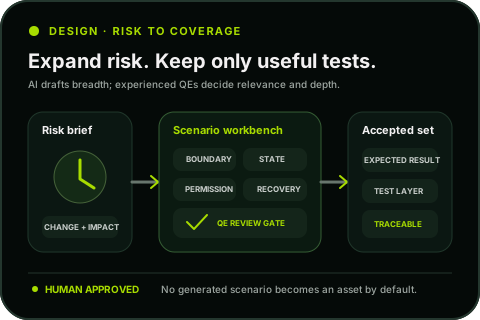
Design
CoreProtect the failures that cost you—not every scenario you can imagine.
AQA turns the selected flow into a risk-ranked validation strategy across happy paths, boundaries, permissions, state changes, integrations, recovery, data, and negative behavior. The goal is not a bigger test-case count. It is a smaller set of checks with a clear reason to exist and an agreed place to run.
Managed activities
- Risk-based scenario design
- Acceptance-criteria and business-rule challenge
- Validation-layer and test-data selection
- Coverage-gap and automation-candidate review
Outputs
- Prioritized scenarios with expected outcomes
- Exploratory charters for uncertain behavior
- Required personas, data, environments, and states
- Agreed implementation plan for the highest-value checks
Human controlAI can multiply scenarios. AQA removes the noise, defines the test oracle, and approves only the coverage worth building and maintaining.
Core scopeIncluded in every pilot
-
Stage : 3
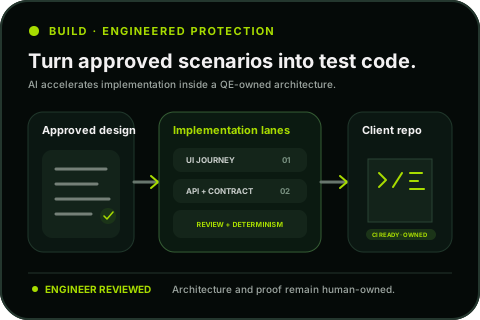
Build
ScopedTurn the best idea into working protection inside your stack.
When implementation is included in scope, AQA builds or hardens the checks, fixtures, configurations, workflows, and quality controls that create the most leverage for the selected flow. AI accelerates repetitive work; the QA Architect chooses the layer, pattern, assertions, and ownership model.
Managed activities
- API, browser, mobile, integration, or performance implementation as scoped
- Reusable fixture and test-data setup
- Assertion, failure-message, and reliability review
- Repository and delivery-workflow integration
Outputs
- Working client-owned checks or quality controls
- Reusable components, fixtures, and configuration
- Layer-appropriate assertions and failure evidence
- Documented implementation decisions and constraints
Human controlAI can draft code. AQA reviews the architecture, proves deterministic behavior, and rejects checks that create activity without confidence.
Scoped scopeApplied when justified by the agreed flow
-
Stage : 4
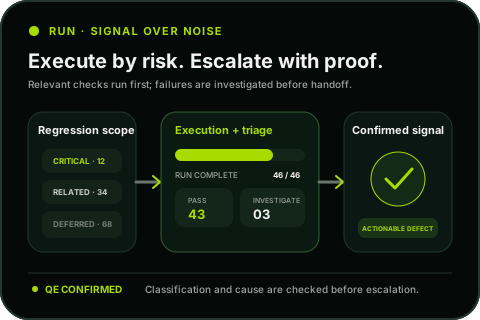
Run
ScopedRun what matters. Return evidence someone can act on.
When execution is included in scope and the environment is available, AQA runs the approved checks against the selected flow and captures what passed, failed, blocked, or could not be tested. Failures are investigated before they become noise for engineering, and every conclusion stays tied to available evidence.
Managed activities
- Risk-informed execution planning
- Approved environment and CI execution
- Failure reproduction and classification
- Defect, blocker, and uncertainty triage
Outputs
- Prioritized execution record
- Pass, fail, blocked, and not-run evidence
- Product, test, environment, or data cause classification
- Actionable defects with reproduction context
Human controlAI can cluster failures and suggest causes. AQA reproduces the behavior and validates the evidence before calling it a product defect.
Scoped scopeApplied when justified by the agreed flow
-
Stage : 5
Maintain
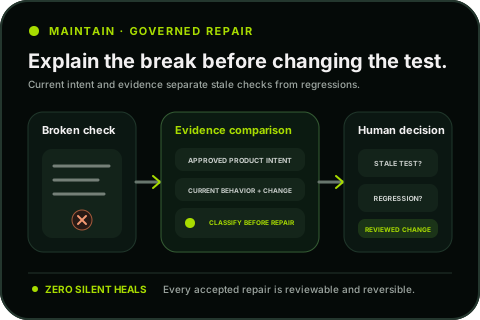
ScopedStabilize the signal before the pilot becomes another maintenance burden.
When maintenance work is included, AQA removes avoidable fragility from the implemented checks and separates stale automation from real regressions. The client receives practical rules for ownership, updates, triage, and future expansion—so Day 14 creates a handover, not a dependency.
Managed activities
- Flake and instability investigation
- Selector, assertion, and test-data hardening
- Test refactoring and duplication review
- Ownership and maintenance workflow design
Outputs
- Stabilized checks with explained changes
- Known reliability limits and cause categories
- Maintenance rules and troubleshooting guidance
- Prioritized backlog for coverage that remains worth adding
Human controlNo silent healing. AQA verifies whether the product changed, the test became stale, or a regression occurred before accepting a repair.
Scoped scopeApplied when justified by the agreed flow
-
Stage : 6
Explain
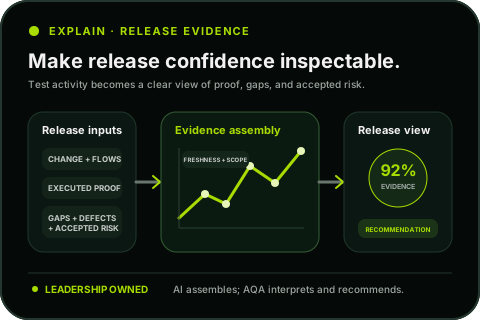
CoreEnd with a decision—not a pile of test activity.
AQA combines the selected flow, implemented work, execution evidence, known gaps, unresolved blockers, and remaining risk into one clear handover. Stakeholders can see what changed, what was validated, what was not, what they own, and which next move creates the most release confidence.
Managed activities
- Evidence and delivered-asset assembly
- Coverage, gap, and remaining-risk review
- Ownership and operating-guidance handover
- Next-decision and priority review
Outputs
- Tested and untested scope with linked evidence
- Delivered assets and client ownership guidance
- Remaining risks, blockers, exclusions, and assumptions
- Practical recommendation for the next highest-value action
Human controlAI can organize the record. AQA leadership owns the interpretation, communicates the uncertainty, and makes the recommendation reviewable.
Core scopeIncluded in every pilot
14-day delivery path
Implementation starts early and stays tied to evidence.
The sequence adapts to access and product complexity without changing the fixed boundary around one critical flow.
-
Days 1–2
Understand
Map product context, architecture, current quality signals, constraints, and release risk.
-
Days 3–4
Design
Prioritize scenarios and decide which implementation creates the most meaningful 14-day leverage.
-
Days 5–10
Build and run
Implement and execute the agreed QA improvements across the layers justified by the selected flow.
-
Days 11–12
Stabilize and integrate
Harden useful checks, connect evidence to current tools where feasible, and prepare ownership guidance.
-
Days 13–14
Explain and hand over
Review evidence, remaining risk, delivered assets, operating guidance, and the recommended next decision.
What AQA builds
Usable QA assets, not a recommendation deck.
The exact mix follows the selected flow. Every included artifact is handed over with its evidence, ownership, and scope boundary visible.
01Implementation
Working controls inside your delivery stack.
Where the selected flow and access support implementation, AQA creates or hardens useful checks and connects their signal to the way your team already delivers software.
Implemented automated tests
Scope-dependent.
High-value tests created or hardened in the client-approved repository and framework.
- Evidence
- Execution results and source location are included when access supports implementation.
- Implemented
- Buyer-owned
- Human-reviewed
- Source-linked
AI QA workflow
Scope-dependent.
A documented, client-approved use of AI for context, scenarios, maintenance, or evidence preparation.
- Evidence
- Inputs, review point, limitations, and accountable owner are explicit.
- Implemented
- Buyer-owned
- Human-reviewed
- Source-linked
Pipeline or reporting integration
Scope-dependent.
Useful test signal connected to an existing delivery, reporting, or triage path.
- Evidence
- Configuration and observed output are included where environment access permits.
- Implemented
- Buyer-owned
- Human-reviewed
- Source-linked
02Product and risk intelligence
A reviewable model of what deserves protection.
The flow, its failure modes, and the coverage response are made explicit so implementation decisions stay connected to product consequences.
Critical-flow map
Core output.
The selected journey, dependencies, failure points, and business consequences in one reviewable map.
- Evidence
- Linked to the product context and observed release conditions.
- Buyer-owned
- Human-reviewed
- Source-linked
Risk register
Core output.
Prioritized product and quality risks with likelihood, impact, evidence, and recommended treatment.
- Evidence
- Each risk cites the available source or observed behavior.
- Buyer-owned
- Human-reviewed
- Source-linked
Test scenarios and coverage model
Core output; depth varies by scope.
Risk-ranked scenarios across the validation layers justified by the selected product flow.
- Evidence
- Reviewed against the agreed success signal and product intent.
- Buyer-owned
- Human-reviewed
- Source-linked
03Handover and decision
Clear ownership after Day 14.
The delivered work includes practical operating guidance and an evidence-based decision, so the client can keep using the assets without a hidden renewal dependency.
Runbook and ownership guide
Included for implemented assets.
How to run, interpret, maintain, and extend the work after handover.
- Evidence
- Responsibilities and known constraints are documented.
- Buyer-owned
- Human-reviewed
- Source-linked
Day 14 decision brief
Core output.
Tested areas, remaining risk, delivered work, and a continue, extend, or stop recommendation.
- Evidence
- Grounded in the pilot evidence rather than borrowed benchmarks.
- Recommended
- Buyer-owned
- Human-reviewed
- Source-linked
Choose the right engagement
Choose how much QA ownership your team actually needs.
The difference is not team size or a feature list. It is the boundary AQA owns after work begins. Start with focused proof, add missing capability around your team, or hand AQA the recurring delivery layer.
01 / Prove the model
14-Day AI-Augmented QA Pilot
This engagement- Choose when
- Choose this when the release problem is real but the right longer-term QA model is not yet proven.
- AQA owns
- One critical flow, one success signal, and the agreed 14-day implementation and evidence boundary.
- Your team keeps
- The delivered assets, evidence, remaining-risk record, and the decision to stop, extend, or scale.
02 / Strengthen your team
QA Leadership & Enablement
- Choose when
- Choose this when your existing team remains responsible for delivery but needs architecture, leadership, or specialist technical leverage.
- AQA owns
- The selected QA Architect, QA Lead, or AI-Augmented QE capability boundary and its agreed outcomes.
- Your team keeps
- Day-to-day QA delivery, product context, final release authority, and agreed AQA-created assets.
03 / Hand over recurring delivery
Managed QA Delivery
- Choose when
- Choose this when AQA must operate recurring QA execution, maintenance, regression, and release evidence—not only advise the current team.
- AQA owns
- The agreed managed QA delivery layer, named responsibilities and capacity, operating cadence, maintenance, and evidence.
- Your team keeps
- Product and release authority, visibility into the work, and the agreed client-owned delivery assets.
Commercial boundary
One critical flow. Clear boundaries from Day 1.
The pilot aligns the work, responsibilities, and expected outputs before delivery starts so every day moves the selected flow forward.
Agreement at a glance
- Duration
- 14 calendar days
- Scope
- One agreed business-critical product flow and one success signal
- Outcome
- Implemented improvements, reviewable evidence, and a clear next decision
- Delivery
- QA architecture, implementation, execution, and evidence according to the agreed scope
- AI
- Client-approved model use with human review and accountable QA judgment
- Access
- NDA and least privilege
- Renewal
- No automatic renewal
Responsibilities and guardrails
Know what each side owns before the clock starts.
-
AQA commitment
Included boundary
- One named product or engineering owner
- One 60-minute kickoff and two 30-minute review checkpoints
- Agreed AQA-created code, configurations, evidence, and runbooks handed over for continued use
-
Your role
Client participation
- Provide scoped access before the delivery clock starts
- Answer product-intent, environment, and access questions in time for delivery
- Review evidence and decisions at the agreed checkpoints
-
Scope guardrails
Not included by default
- Whole-product transformation or unlimited testing
- Equal implementation depth across every testing layer
- Elimination of release risk or autonomous AI release decisions
- Transfer of pre-existing AQA materials or third-party ownership rights
Decision value
The handover separates proven protection from remaining risk and makes the next move clear.Ownership
AQA-created pilot assets are handed over for continued use. Pre-existing AQA and third-party materials keep their existing terms.Fit filter
Built for a team ready to improve one meaningful release path.
A focused scope creates the room to implement meaningful improvements in 14 days.
Not built for
Built for
-
Unlimited testing or an entire-product transformation
A meaningful release or quality bottleneck exists
-
A broad assessment with no implementation path
One critical flow and success signal can be selected
-
Delivery without product context, access, or an available owner
A product or engineering owner can participate
-
Generic recommendations with no implementation
Scoped access can be ready before Day 1
-
Headcount alone without operating-model change
The team wants implementation, not another assessment
-
A team unable to act after Day 14
The team can act on the resulting evidence
Direct answers about implementation, access, ownership, and Day 14.
The visible answers below are also the source used for structured FAQ data.
It is hands-on implementation inside one agreed critical flow. Analysis identifies the leverage; the team then builds, runs, or integrates the QA improvements that matter most.
The team can map the selected flow, prioritize risk, create human-reviewed scenarios, implement agreed high-value checks or workflows, produce evidence, and hand over a next decision. The exact mix depends on complexity, access, and the starting condition.
No. QA leadership, risk framing, and evidence are core. AI QA enablement, automation, and CI/CD work are included only where they create the strongest leverage for the selected flow and are approved in scope.
API, browser, mobile, integration, and performance layers can be considered. The engagement does not promise equal depth across every layer; it prioritizes the layers that best protect the agreed flow.
No single model is guaranteed. Any model use is agreed with the client, limited to approved context, and kept inside a human-governed workflow with accountable review.
No. Access starts with the least privilege needed for the agreed work. Production access is not assumed, and unavailable access can change which outputs are implemented rather than recommended.
Confidentiality, approved tools, access boundaries, and data handling are agreed before delivery. Sensitive context is used only within that boundary and is not turned into public example material.
Your team keeps the agreed AQA-created pilot assets and can continue using them after Day 14. Pre-existing AQA and third-party materials keep their existing terms.
The pilot succeeds when the selected flow is better understood, materially better protected, and easier to make a release decision about. Day 14 evidence shows what improved, what remains exposed, which assets the team now owns, and whether the next best decision is to stop, extend, or scale.
The client receives the agreed assets, evidence, remaining risks, and a recommendation to stop, extend the selected scope, or scale the model. Any follow-on work is a separate decision.
Yes. There is no automatic renewal or long-term lock-in. Your team can keep using the delivered assets and evidence after Day 14.