

How We Engage Modular senior QA capability

Add the QA capabilities your existing team is missing.

Bring in a QA Architect, QA Lead, AI-Augmented QE—or the right combination—to improve quality strategy, delivery rhythm, automation, and release evidence without replacing the team that already knows your product.

Engagement at a glance

Add one layer or connect all three around the outcome your team needs.

Model
One, two, or three capability layers
Works with
Your existing Product, Engineering, and QA teams
Entry
One scoped problem or the 14-Day AI-Augmented QA Pilot
Ownership
Client-owned assets and final release decisions

Independent review profiles

Independent evidence, clearly linked to its source.

Review AQA Masters on the independent platforms below before deciding whether the model deserves a place in your delivery system.

The capability gap

Your team may not need more testers. It may need a missing layer.

Adding general capacity to an unclear quality system creates more activity, not more confidence. The useful intervention is the smallest capability that changes the decision or bottleneck holding the team back.

What the team experiences

Tests exist, but nobody can explain which customer journeys deserve protection first or where automation creates the most leverage.

What the missing layer changes

A QA Architect connects business risk, system architecture, coverage layers, and automation priorities into one reviewable quality model.

What the team experiences

Capable QA engineers are spread across tickets and squads while release-readiness, triage, priorities, and reporting change every sprint.

What the missing layer changes

A QA Lead installs the operating rhythm, ownership, and decision signal that lets the existing team execute as one system.

What the team experiences

The team knows what should improve, but automation, maintenance, evidence preparation, or specialist validation cannot keep up.

What the missing layer changes

An AI-Augmented QE adds focused, human-governed execution exactly where the approved quality model needs more leverage.

What the team experiences

Leaders consider replacing the team or starting a long senior-hiring cycle because the current model is not producing confidence.

What the missing layer changes

Add only the missing capability, keep product knowledge in the team, and expand the engagement only when evidence justifies it.

The three-layer mechanism

3layers

Independently useful.
More powerful when the problem crosses layers.

One quality system. Add only the layer that changes the outcome.

These are not interchangeable job titles or generic staff augmentation. Each layer owns a different constraint: system direction, operating discipline, or specialist execution.

  1. System direction

    QA Architect

    Defines the quality model: critical flows, risk boundaries, coverage layers, automation direction, AI guardrails, release gates, and the ownership design your team can scale.

    SelectableAvailable independently or in combination

  2. Operating discipline

    QA Lead

    Turns the model into an operating rhythm: planning, prioritization, coordination, triage, reporting, quality metrics, and evidence-led release-readiness reviews.

    SelectableAvailable independently or in combination

  3. Technical leverage

    AI-Augmented QE

    Adds focused technical leverage: human-reviewed analysis, test design, automation, maintenance, specialist validation, and source-linked evidence inside the agreed scope.

    SelectableAvailable independently or in combination

Built around your current team

Keep the context. Add the capability. Make ownership explicit.

AQA does not need to replace your QA team to create leverage. The engagement defines what your team keeps, what AQA owns, and where decisions meet.

01 / Client context

Your team keeps

  • Product intent and business priorities
  • Day-to-day product knowledge
  • Engineering and release authority
  • Final acceptance of risk and release decisions
02 / Selected capability

AQA adds

  • The selected senior or specialist capability
  • A clear operating boundary and cadence
  • Human-governed implementation and evidence
  • Client-owned assets, guidance, and handover
03 / Shared outcome

Together, the system produces

  • Risk-ranked priorities
  • More dependable coverage
  • Actionable release evidence
  • A next decision grounded in observed results

From product context to decision signal

The layers work through one evidence-led operating rhythm.

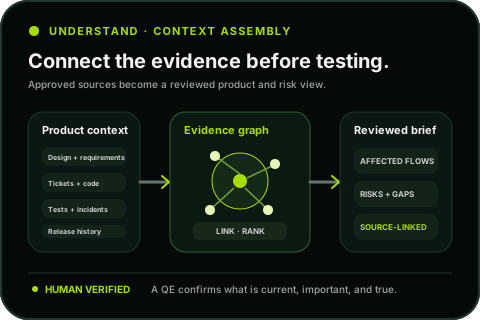
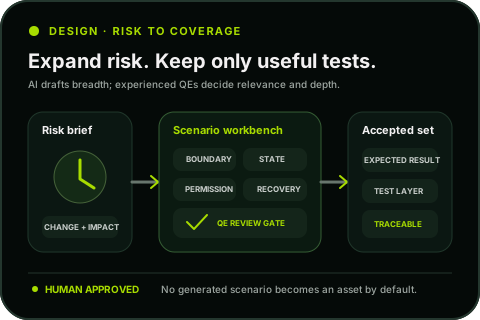
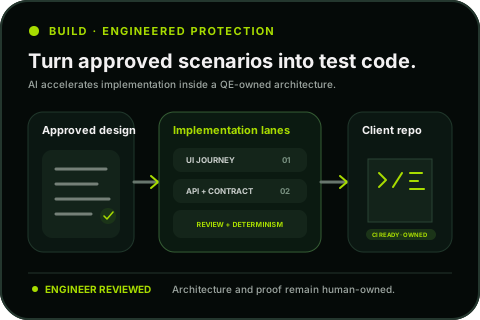
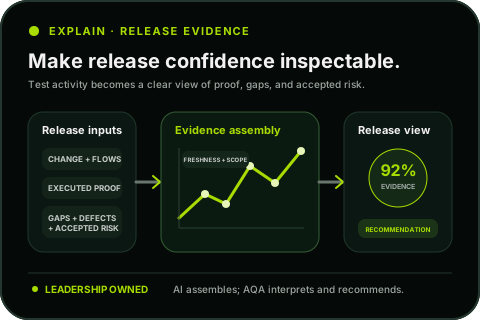
The exact cadence changes with scope. The logic does not: understand the product risk, decide what deserves protection, improve the approved bottleneck, and explain what the evidence supports.

  1. Stage : 1

    Frame the risk

    Connected

    Make the product consequence visible before choosing the QA work.

    AQA reviews approved product context, architecture, incidents, release history, existing tests, and delivery constraints. The team agrees which business-critical flow, decision, or bottleneck the engagement must improve.

    Activities
    • Critical-flow and dependency mapping
    • Existing signal and incident review
    • Constraint and access discovery
    • Success signal and ownership definition
    Outputs
    • Agreed problem boundary
    • Risk-ranked product context
    • Current capability-gap assessment
    • Named client and AQA decision owners

    Human controlAI may organize approved context. A QA Architect or QA Lead validates what is current, material, and safe to use.

    Connected modelRuns across the agreed capability layers

  2. Stage : 2

    Design the response

    Connected

    Choose the smallest capability mix that can change the outcome.

    The quality model ties each risk to the useful coverage layer, operating change, or specialist implementation. Work is prioritized by decision value rather than test count or tool novelty.

    Activities
    • Coverage and control design
    • Automation and AI workflow decisions
    • Cadence and responsibility design
    • Scope, exclusions, and review-point agreement
    Outputs
    • Capability and ownership model
    • Risk-ranked implementation backlog
    • Evidence standard and review gates
    • Explicit scope boundaries

    Human controlAQA leadership approves the quality model. AI does not choose release policy, risk appetite, or what deserves trust.

    Connected modelRuns across the agreed capability layers

  3. Stage : 3

    Create leverage

    Connected

    Improve the bottleneck inside the client’s real delivery system.

    The selected layers implement the agreed changes: architecture guidance, team cadence, test assets, automation, maintenance, specialist validation, or evidence workflows. Work stays connected to the client repository and operating tools wherever access permits.

    Activities
    • Leadership cadence and decision reviews
    • Test or workflow implementation
    • Signal hardening and failure triage
    • Team guidance and knowledge transfer
    Outputs
    • Working controls and operating practices
    • Reviewable implementation evidence
    • Updated priorities and ownership
    • Known limits, blockers, and remaining risk

    Human controlAI can accelerate drafts and implementation. Qualified AQA judgment reviews the work and rejects output that does not improve confidence.

    Connected modelRuns across the agreed capability layers

  4. Stage : 4

    Make the decision clear

    Connected

    Turn QA activity into evidence leaders and teams can act on.

    AQA brings together what changed, what was validated, what remains exposed, and who owns the next action. The client keeps final release authority and receives a clear recommendation to stop, continue, or expand the capability mix.

    Activities
    • Evidence and outcome review
    • Coverage and remaining-risk assessment
    • Handover and operating guidance
    • Continue, change, or stop recommendation
    Outputs
    • Decision-ready evidence brief
    • Client-owned asset inventory
    • Remaining-risk and ownership record
    • Prioritized next move

    Human controlAI may assemble evidence. AQA leadership owns the interpretation, states uncertainty, and keeps the recommendation reviewable.

    Connected modelRuns across the agreed capability layers

Time to value

Useful evidence first. Expansion only after it earns its place.

The sequence reduces hiring delay and transformation risk without pretending a complex quality system changes overnight.

  1. Days 1–14

    Prove the model

    Use the Pilot or a tightly scoped first engagement to expose risk, implement useful changes, and identify the capability that creates leverage.

  2. Days 15–30

    Install the layer

    Establish responsibilities, operating cadence, priority backlog, evidence standard, and the first client-owned assets.

  3. Days 31–60

    Harden the signal

    Improve weak coverage, stabilize useful controls, reduce avoidable noise, and make ownership work through normal delivery.

  4. Days 61–90

    Scale or hand over

    Expand only the proven capability, transfer operating knowledge, or stop with the created assets and next-decision record intact.

The value stack

Buy a stronger capability. Keep the assets it creates.

The exact outputs follow the selected layers and scope. Every delivered artifact exposes its owner, evidence, limits, and next use so value does not depend on a permanent vendor black box.

01QA Architect

A quality model tied to product risk.

Architecture work gives the existing team a durable answer to what matters, how it should be protected, and where QA investment should go next.

Included artifacts

2 architecture outputs

Risk and critical-flow model

Core QA Architect output.

Business-critical journeys, dependencies, failure consequences, current controls, and meaningful gaps in one reviewable model.

Evidence
Linked to approved product context, observed behavior, incidents, and current delivery conditions.
  • Client-owned
  • Human-reviewed
  • Source-linked

Quality architecture roadmap

Core QA Architect output.

Coverage layers, automation direction, AI guardrails, quality gates, tooling decisions, and sequenced investment priorities.

Evidence
Each recommendation connects to a named risk, constraint, owner, and expected decision value.
  • Client-owned
  • Human-reviewed
  • Source-linked

02QA Lead

An operating rhythm teams can follow.

Leadership work turns strategy into priorities, ownership, evidence reviews, and release-readiness decisions that survive the next sprint.

Included artifacts

2 leadership outputs

QA operating charter

Core QA Lead output.

Responsibilities, planning cadence, triage rules, evidence reviews, metrics, escalation points, and release-readiness responsibilities.

Evidence
Installed through the agreed team ceremonies and refined against observed delivery behavior.
  • Implemented
  • Client-owned
  • Human-reviewed

Release evidence brief

Core QA Lead output.

A repeatable view of tested scope, meaningful failures, blockers, known gaps, accepted risk, and the recommended next action.

Evidence
Grounded in current source evidence and explicit uncertainty rather than a generic pass rate.
  • Implemented
  • Client-owned
  • Human-reviewed
  • Source-linked

03AI-Augmented QE

Focused execution where it creates leverage.

Specialist work implements or hardens the approved controls while human judgment stays accountable for quality and evidence.

Included artifacts

2 execution outputs

Implemented quality controls

Scope-dependent AI-Augmented QE output.

Approved tests, automation, fixtures, integrations, specialist checks, or evidence workflows created in the client delivery context.

Evidence
Source location, execution result, constraints, and ownership guidance accompany implemented work.
  • Implemented
  • Client-owned
  • Human-reviewed
  • Source-linked

Maintenance and handover guide

Included for implemented assets.

How to run, interpret, troubleshoot, maintain, and extend the delivered controls without silent AI healing or hidden dependency.

Evidence
Guidance reflects the implemented assets, known failure modes, and agreed team ownership.
  • Implemented
  • Client-owned
  • Human-reviewed
  • Source-linked

Choose the right engagement

Choose how much QA ownership your team actually needs.

The difference is not team size or a feature list. It is the boundary AQA owns after work begins. Start with focused proof, add missing capability around your team, or hand AQA the recurring delivery layer.

01 / Prove the model

14-Day AI-Augmented QA Pilot

Choose when
Choose this when the release problem is real but the right longer-term QA model is not yet proven.
AQA owns
One critical flow, one success signal, and the agreed 14-day implementation and evidence boundary.
Your team keeps
The delivered assets, evidence, remaining-risk record, and the decision to stop, extend, or scale.

03 / Hand over recurring delivery

Managed QA Delivery

Choose when
Choose this when AQA must operate recurring QA execution, maintenance, regression, and release evidence—not only advise the current team.
AQA owns
The agreed managed QA delivery layer, named responsibilities and capacity, operating cadence, maintenance, and evidence.
Your team keeps
Product and release authority, visibility into the work, and the agreed client-owned delivery assets.

Commercial boundary

One consequential constraint. The smallest capability mix that can change it.

The fit call defines the problem before it defines the team. Scope, responsibilities, access, outputs, review points, and continuation criteria are agreed before delivery begins.

Agreement at a glance

Capability
QA Architect, QA Lead, AI-Augmented QE, or an agreed combination
Scope
One defined outcome, operating constraint, or product-risk boundary
Team model
Works alongside the client’s existing Product, Engineering, and QA team
Outputs
Agreed implemented assets, operating guidance, and evidence
AI
Client-approved use with human review and accountable QA judgment
Ownership
Client keeps final release authority and agreed AQA-created assets
Expansion
Additional layers or scope require a separate evidence-based decision

Responsibilities and guardrails

Know what each side owns before delivery begins.

  1. AQA commitment

    AQA responsibility

    • Own the agreed capability boundary and delivery cadence
    • Make assumptions, evidence, limits, and recommendations reviewable
    • Hand over agreed AQA-created assets and operating guidance
  2. Your role

    Client participation

    • Name a Product or Engineering decision owner
    • Provide scoped context and least-privilege access
    • Review decisions, evidence, and operating changes at agreed checkpoints
  3. Scope guardrails

    Not included by default

    • A named Embedded QE or unlimited day-to-day testing capacity
    • Whole-product transformation without a defined starting boundary
    • Autonomous AI release decisions or a zero-defect guarantee
    • Transfer of pre-existing AQA or third-party ownership rights

Decision value

The team buys the missing capability and receives evidence of whether it should stop, continue, or expand.

Ownership

Agreed AQA-created assets are handed over for continued use. Pre-existing AQA and third-party materials keep their existing terms.

Fit filter

Built for teams that want missing capability—not replacement headcount.

The model works when the client has product context worth preserving and a meaningful quality constraint worth changing.

Wrong engagement

Wrong engagement

Strong fit

Strong fit

  1. The only requirement is a named full-time manual tester

    An existing QA, Engineering, or Product team owns valuable product context

  2. The expectation is unlimited execution without a scope boundary

    A senior architecture, operating, or specialist execution gap is visible

  3. The client cannot provide context, access, or a decision owner

    One meaningful outcome or constraint can define the starting boundary

  4. AI is expected to make autonomous quality or release decisions

    A client decision owner can participate in evidence reviews

  5. The team wants generic advice with no operating or implementation change

    The team wants client-owned assets and knowledge transfer

  6. AQA is expected to own all recurring QA delivery without using Managed QA Delivery

    Expansion will be decided from observed evidence

Questions before scope

Direct answers about layers, ownership, execution, and fit.

The model should be easy to reject when it is wrong and easy to understand when one missing capability is holding the team back.

Existing teamCapability layersAI governanceOwnershipEngagement path

No. This engagement is designed to strengthen the team you already have. Your people keep product context and day-to-day ownership. AQA adds the agreed architecture, leadership, specialist execution, or combination.

Start with the constraint

Do not hire around a problem you have not isolated.

Bring one quality bottleneck to a 30-minute fit call. Map the missing layer, the evidence it must produce, and whether AQA is the right way to add it.

NDA before access Least-privilege scope Every asset stays yours No long-term lock-in
Horia Adamov, QA Architect
Your call host

Horia Adamov

QA Architect