Turn every product change into tests your team can trust.
Bring together the designs, requirements, tickets, repositories, test history, and product knowledge your team approves. AQA uses AI to accelerate test design, automation, maintenance, and release evidence while experienced QEs remain accountable for what is accepted and communicated.
AI assists. Tools execute. Experienced QEs approve.
Product context
Design
Knowledge & decisions
Planning
Code & APIs
Test management
Delivery
Signals & support
Human governed
AQA workflows
Understand
Design
Build
Run
Maintain
Explain
Human-approved outputs
Test plansCreated in
AutomationImplemented with
TraceabilityMapped in
DefectsOpened in
Test signalPublished through
Release evidenceShared in
Representative destinations. Final tools and publishing steps are agreed per engagement.
Stage : 01
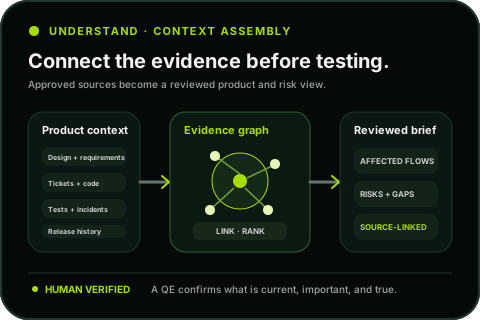
Understand
Give AI the context your best QE would ask for.
AQA brings together approved designs, requirements, tickets, repositories, existing tests, incidents, roles, business rules, integrations, and release history. AI helps connect the evidence; an Embedded QE confirms what is current, important, and true.
Managed activities
Product context assembly
Requirements and design review
Change impact analysis
Related-service and repository impact
Outputs
Product and Quality Context Pack
Affected actors, flows, rules, services, and data
Missing-context questions
Risk-ranked change brief with source-linked assumptions
Human controlAI can infer impact. AQA decides whether the inference matters to the product.
Stage : 02
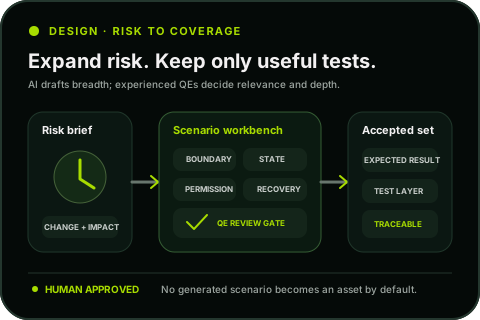
Design
Start with risk—not a blank test-case template.
AI expands happy paths into negative, boundary, state, permission, integration, recovery, and data scenarios. AQA QEs remove noise, add product intuition, define expected outcomes, and select the right validation layer.
Managed activities
Risk-based test design
Exploratory charter creation
Acceptance-criteria challenge
Test data and state design
Coverage gap analysis
Outputs
Human-reviewed scenarios and exploratory charters
Required personas, roles, and data states
Expected results and test oracles
Risk-to-requirement-to-test traceability
Automation candidate backlog
Human controlNo AI-generated scenario becomes an accepted asset until a QE verifies its relevance, expected outcome, and maintenance value.
Stage : 03
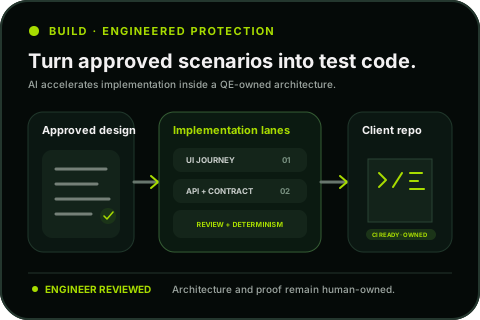
Build
Generate less boilerplate. Build more useful protection.
AQA uses AI to accelerate implementation, refactoring, documentation, and coverage expansion. The QA Architect chooses the layer and pattern; engineers review the code and keep approved assets in the client repository.
Managed activities
UI journey automation
API and contract automation
Accessibility checks and human validation
Visual regression
Performance, resilience, mobile, and cross-platform work when scoped
Outputs
Client-owned test code and reusable components
CI-ready suites and fixtures
Layer-appropriate assertions
Runbooks and maintenance rules
Human controlAI proposes and accelerates code. AQA owns architecture, review, deterministic execution, and whether the test proves meaningful behavior.
Stage : 04
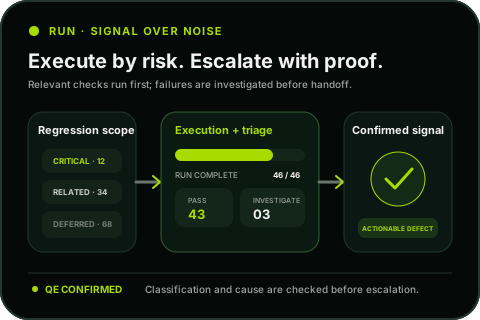
Run
Run the tests that matter. Escalate failures worth acting on.
AQA can use approved change, risk, history, dependencies, and evidence freshness to recommend regression scope. When a check fails, AI accelerates investigation while QEs confirm the cause before escalating it.
Managed activities
Risk-informed regression planning
CI and scheduled execution
Failure classification
Defect reproduction and enrichment
Duplicate and incident correlation
Outputs
Prioritized execution plan
Pass, fail, blocked, and not-run evidence
Product, test, environment, or data classification
Reproduction artifacts and actionable defect report
Known uncertainty and blockers
Human controlAI can cluster and suggest a cause. A QE reproduces and validates it before engineering receives a product defect.
Stage : 05
Maintain
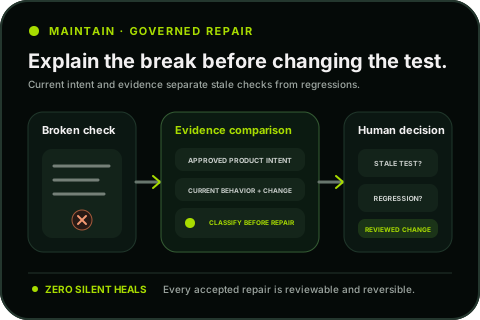
Repair stale tests without hiding regressions.
When a test breaks, the workflow compares approved product intent, the code change, current behavior, and previous evidence. AI can propose a repair; AQA determines whether the product changed intentionally, the test became stale, or a regression occurred.
Managed activities
Governed repair proposals
Flaky-test detection
Test refactoring and consolidation
Stale coverage detection
Incident-to-regression learning
Outputs
Explained test repair proposal
Human-approved change in the client repository
Flake evidence and cause category
Updated coverage map
Permanent regression guard after an incident
Human controlZero silent heals. Every accepted repair is reviewable, attributable, validated, and reversible.
Stage : 06
Explain
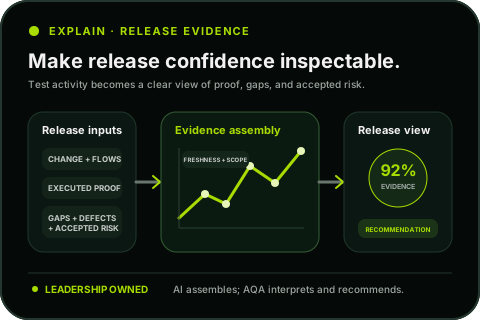
Turn test activity into release evidence.
AQA combines the change, affected flows, executed evidence, known gaps, defects, and accepted risk into one release view so stakeholders can see what was validated, what was not, and what must happen next.
Managed activities
Release evidence assembly
Coverage and risk reporting
Known-risk and exception tracking
Quality trend and capacity reporting
Outputs
Tested and untested scope with evidence freshness
Critical blockers and owners
Accepted risks and exclusions
Release-readiness recommendation when included in scope
Workflow learning priorities
Human controlAI assembles the evidence. AQA leadership owns the interpretation and any recommendation.
Public Edition in action
Watch one pull request become an evidence-backed QA brief.
AQA Change Review keeps the scope, AI destination, supporting evidence, and resulting QA direction visible at every step—so your team can inspect the reasoning before it acts.
04capabilities one controlled review
Recorded product walkthrough
Recorded product walkthrough
Capability 01
Start with one bounded change.
Register an open GitHub pull request, add only the product context the repository cannot explain, and choose a configured AI model before any assessment begins.
Pull request scope
Model selection
Related repositories
Recorded product walkthrough
Capability 02
See exactly what leaves the machine.
Inspect commit pins, selected evidence, exclusions, redactions, token estimate, credential status, and AI destination. Provider transmission requires explicit approval.
Context Pack
Destination check
Explicit approval
Recorded product walkthrough
Capability 03
Move from change intent to test direction.
Review the product brief, ranked risk hypotheses, prioritized QA scenarios, exploratory charters, and cross-service impact—with material claims linked back to approved evidence.
Risk hypotheses
QA scenarios
Service impact
Recorded product walkthrough
Capability 04
Return to reviews without losing control.
Manage trusted model configurations and reopen completed or in-progress assessments from local history. Credentials are handled by the operating-system credential manager.
Local history
Model profiles
Credential status
i
Direction with a visible evidence trail.The Public Edition analyzes source and repository context; it does not execute the product or tests. Risks remain hypotheses for human review—not verified defects or a release decision.
Animation stays off when your device requests reduced motion or data.
Choose your edition
Get clear QA direction now. Add accountable delivery when the work needs to get done.
Use the Public Edition to uncover risk and shape your test plan. Managed Delivery turns that direction into implemented, executed, and maintained tests—with clear release evidence.
Scroll to compare editions →
Capability comparison between AQA Public Edition and AQA Managed Delivery
Compare editionsWhat’s included
One capability list. Two ways to start.
Public EditionOpen access
A reusable, self-directed QA workflow for public and locally configured private GitHub repositories.
Available on GitHub
Managed DeliveryOutcome-led partnership
A named AQA team builds and operates the workflows needed to reach the agreed QA outcome.
Human governed
Context and directionHow each edition understands a change and turns it into a useful QA direction.
Starting point
One open GitHub pull request per assessment
Your highest-value QA bottleneck, roadmap, changes, and releases
Sources
Pull request, changed files, and available repository context
Approved designs, docs, tickets, repositories, tests, incidents, and product signals
Product knowledge
•One assessment with no persistent product model
Maintained and corrected across the engagement
Change impact
Evidence-backed hypotheses for user interpretation
Human-reviewed product and business interpretation
Test scenarios
Prioritized conceptual scenarios
Approved test cases, exploratory charters, and maintained assets
Build and operateThe delivery work that turns QA direction into repeatable protection.
UI automation
—Not included
Designed, implemented, executed, and maintained
API and contract automation
—Not included
Designed, implemented, executed, and maintained
Accessibility, visual, and specialist testing
•Relevant considerations may be suggested
Agreed automation and human specialist validation
Test data
•Requirements may be identified
Fixtures and synthetic data implemented and maintained
Execution
—Not included
Manual, exploratory, CI, and scheduled execution
Failure triage
—Not included
AI-assisted and human-confirmed classification
Test repair
—Not included
Governed proposals, human review, and deterministic rerun
Evidence and ownershipWhat remains after the review and who stays accountable for the result.
Coverage memory
•One report with no ongoing memory
Maintained requirement-risk-test-evidence map
Release evidence
•No release recommendation or decision
Human-reviewed evidence and recommendation
Asset ownership
—No implementation assets
Agreed test code and runbooks remain accessible to the client
Accountability
•The user interprets the output
A named AQA team owns agreed delivery and evidence
Commercial model
Free and reusable; one pull request per assessment
A scoped investment tied to the agreed outcome, workflow coverage, and delivery capacity
Managed capabilities apply only when included in the engagement scope. The client retains the release decision.
One managed service
One service. Three connected workflow groups.
Start with the bottleneck costing your team the most confidence or time. AQA connects the right workflow groups into one human-governed delivery service—not a software tier or an à-la-carte tool.
Connect product evidence to risk, scenarios, and better QA decisions.
What this workflow group delivers
Product-context assembly
Requirements and design review
Change-impact analysis
Test-case and exploratory design
Coverage intelligence
Test-data design
Best forTeams that already have execution capacity but need better direction and senior QA thinking.
Turn approved testing knowledge into client-owned, repeatable protection.
What this workflow group delivers
Automation architecture
UI automation
API and contract automation
Accessibility and visual checks
CI integration
Selected specialist automation
Client-owned code and runbooks
Best forTeams whose manual knowledge is not becoming repeatable protection.
Operate the agreed QA capability across changes, releases, and maintenance.
What this workflow group delivers
Named Embedded QE capacity
Manual and exploratory execution
Risk-based regression
Human-confirmed failure triage
Governed repair and suite maintenance
Release evidence and workflow metrics
Shared QA Lead, Architect, and specialist support
Best forTeams that want AQA to operate the capability, not just build assets.
FAQ
Know exactly what each edition does.
The Public Edition gives you immediate QA direction. Managed Delivery adds the people, implementation, operation, and accountability needed to turn direction into durable release protection.
Service modelAI controlsDelivery scopeOwnership
No. AQA Masters is a QA service. We use AI inside human-governed workflows to accelerate analysis, design, implementation, maintenance, and reporting. Your team does not have to operate another QA platform.
AI can produce source-linked drafts and variations from approved context. AQA QEs review relevance, expected results, risk, duplication, and maintenance value before a test becomes an accepted managed asset.
Yes. Managed Delivery can use approved designs, requirements, tickets, code, existing tests, incidents, and product knowledge. We agree how each source is accessed—manually or through an approved integration—before it enters the workflow.
Depending on product risk and agreed scope, managed work can include UI, API, contract, accessibility, visual, performance, mobile, integration, data, and AI-product evaluation coverage. The QA Architect selects the useful layer rather than automating everything through the UI.
No. AQA does not silently accept AI-proposed repairs. We first distinguish product, test, environment, and data causes. Every accepted repair is explained, reviewed by a QE, committed through the agreed client workflow, and proven by a deterministic rerun.
The Public Edition is a free, reusable, self-directed workflow. Each assessment uses one pull request and available repository context to produce evidence-backed impact hypotheses and prioritized test scenarios for your interpretation. It does not execute tests, commit automation, or provide an AQA release decision.
Depending on agreed scope, Managed Delivery adds maintained product context, human-approved test design, automation implementation, manual and exploratory work, execution, triage, governed maintenance, coverage records, release evidence, and named QA accountability.
Not necessarily. AQA can work around an existing team, fill missing architecture or automation capability, or provide Embedded QE capacity with shared senior and specialist support.
Agreed managed assets are created in client-approved systems and repositories so the client retains access and ownership under the engagement terms. Exact ownership, licensing, access, and handover terms are confirmed in the agreement.
We define a baseline, current period, unit, formula, scope, exclusions, and source evidence for each selected workflow metric. We report the measured difference for comparable periods rather than applying a generic AI productivity percentage.
Choose a starting point.
Improve one QA workflow.
Bring one workflow and its current constraints to a fit call with AQA.
NDA before accessLeast-privilege scopeEvery asset stays yoursNo long-term lock-in