

Case Study Cloud Infrastructure · Managed QA Delivery

How an Enterprise IaC Management Platform Automated 96% of Its Workflow Regression Suite

Rapid product expansion had turned QA into a scaling problem. Manual-heavy regression and fragmented product knowledge made each new workflow harder to validate and every release more difficult to assess with confidence. AQA Masters embedded a three-person team to establish ownership, build reusable UI/API automation, and create a dependable release signal—ultimately automating 96% of the agreed workflow regression suite.

Engagement summary

An embedded QA team turned fragmented coverage into a maintained, 96%-automated regression system.

Engagement
Embedded managed QA delivery
Delivery team
Three AQA Masters specialists
Product surface
Enterprise SaaS, web application, and API product
Verified outcome
96% of agreed workflow regression automated
Verified outcome

A Maintained QA System Produced Measurable Release Evidence

  • Measured outcome 96%

    Workflow regression automated

    Measured against the agreed and maintained workflow regression inventory.

    Period
    Across the managed QA engagement
    Denominator
    Agreed and maintained workflow regression inventory
  • Measured outcome 3.2×

    Core automation growth

    Growth of the maintained core automation suite during the approved comparison period.

    Period
    Across the managed QA engagement
    Denominator
    Maintained core automation suite at the comparison baseline
  • Measured outcome ~700

    Documented QA scenarios

    Traceable scenarios protecting approved product behavior across the covered product areas.

    Period
    Across the managed QA engagement
    Denominator
    Maintained and traceable QA scenario inventory
  • Measured outcome 100%

    Automated suite enabled for parallel CI execution

    The complete maintained automated suite could run through the approved parallel CI configuration.

    Period
    Across the managed QA engagement
    Denominator
    Complete maintained automated suite
The Company Behind the Product

The Product Was Scaling. Its Quality System Had to Scale With It.

Behind this project is a European growth-stage software company building an enterprise IaC management platform for platform engineering, cloud, DevOps, and security teams. The product helps organizations turn fragmented infrastructure work into controlled, policy-driven workflows. As the company expanded across Europe and the United States, every new capability, role, integration, and operating context raised the quality bar—and increased the cost of releasing without dependable evidence.

  1. Fact : 1

    What the Platform Enables

    Product context

    The platform turns fragmented infrastructure work into governed, connected journeys.

    The enterprise SaaS platform gives teams a controlled way to discover, codify, govern, and orchestrate cloud infrastructure. Web and API workflows connect infrastructure definitions, cloud accounts, version control, permissions, policies, environments, and execution into journeys where one change can affect many connected behaviors.

    Platform responsibilities
    • Discover and codify cloud infrastructure
    • Apply governance, permissions, and policy
    • Orchestrate infrastructure work across environments
    Connected product context
    • Infrastructure definitions and cloud accounts
    • Version control, roles, and policy-driven decisions
    • Web and API execution across complete journeys

    Product reality A change rarely stays inside one screen because the platform coordinates decisions across systems, roles, and environments.

    QA lens Protect complete infrastructure journeys and their connected rules, not isolated interface behavior.

  2. Fact : 2

    The Business Moment

    Growth context

    Product growth was creating release complexity faster than the existing quality system could absorb it.

    The company was moving through a new phase of product and market expansion across Europe and the United States. More capability created more opportunity, but also more regression paths, edge cases, and release decisions that could no longer depend on fragmented product knowledge or a manual-first process.

    What was expanding
    • Product capability and connected workflows
    • Operating contexts across Europe and the United States
    • Roles, integrations, environments, and edge cases
    What had to mature
    • Shared and reviewable product knowledge
    • Risk-based regression coverage
    • Evidence used to make release decisions

    Scaling pressure Adding capability without strengthening quality evidence would increase the cost and uncertainty of every release.

    Strategic need The quality system had to become an enabler of growth rather than a manual gate at the end of delivery.

  3. Fact : 3

    How QA Was Embedded

    Engagement model

    QA moved inside delivery so evidence could shape decisions before the final gate.

    Three AQA Masters specialists worked through an embedded managed QA delivery model. The team operated inside the delivery context—not as a final testing gate—so product knowledge, risk, coverage, defect evidence, automation, and release readiness could become part of one shared operating rhythm.

    Embedded responsibilities
    • Product-context and risk discovery
    • Coverage, defects, and automation direction
    • Regression and release-readiness evidence
    Shared operating rhythm
    • QA participation throughout delivery
    • Traceable evidence and clearer ownership
    • Continuous review as the product changed

    Team model Three specialists worked as an embedded quality capability while product and engineering ownership remained with the client.

    Control point QA informed release readiness with evidence; it did not replace accountable product and engineering decisions.

  4. Fact : 4

    What the Team Protected

    Protection scope

    The real test surface was the infrastructure journey—not a checklist of disconnected test types.

    The scope connected functional and exploratory testing with API, UI, regression, performance, and CI execution. That breadth mattered because the product promise did not live in one screen: it depended on complete infrastructure journeys continuing to work across roles, integrations, environments, and policy-driven workflows.

    Quality capabilities
    • Functional and exploratory investigation
    • API, UI, and regression protection
    • Performance checks and CI execution
    Protected behavior
    • Workflows across different roles and permissions
    • Integrations and environment-dependent behavior
    • Policy-driven infrastructure journeys end to end

    Coverage principle Test techniques were selected around risk and connected behavior rather than treated as separate service lines.

    Release signal Evidence had to explain whether critical journeys still worked—not merely whether individual checks passed.

The Diagnosis

The Bottleneck Was Fragmentation, Not Testing Capacity

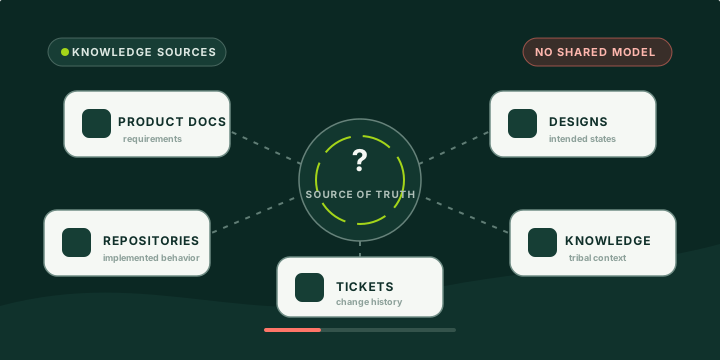
The client did not simply need more people executing more checks. It needed one operating model connecting product context, risk-based test design, defect intelligence, automation, CI execution, and QA ownership.

  1. Mechanism 01

    Traceable coverage

    Product sources, expected behavior, maintained scenarios, and critical workflows became easier to review and expand.

  2. Mechanism 02

    Reusable protection

    A unified UI/API foundation and reusable abstractions reduced disconnected execution and duplicated automation effort.

  3. Mechanism 03

    Shared ownership

    Evidence, severity, responsibility, status, retesting, and closure followed a clearer operating cadence across delivery.

  4. Mechanism 04

    Clearer CI release signal

    Standardized execution, reports, traces, and artifacts made automation results usable before the final release decision.

The QA Roadmap We Implemented

Product Context First. Then Ownership, Automation, and Continuous Expansion.

AQA Masters learned how the platform behaved across roles and environments before adding process or automation. Ownership was clarified first, then automation and coverage expanded around the workflows carrying the greatest release risk.

  1. Phase 01

    Product Onboarding and Risk Discovery

    Action

    Learned the platform’s roles, environments, integrations, terminology, release rhythm, and connected workflows through product alignment and exploratory testing.

    Client-owned asset

    Product-risk map, workflow inventory, documented product context, and prioritized coverage backlog.

    Operational result

    The team gained a shared view of the behaviors that required the earliest and strongest protection.

  2. Phase 02

    QA Enablement and Ownership

    Action

    Standardized issue evidence, severity, ownership, status transitions, retesting, traceability, and QA participation throughout delivery.

    Client-owned asset

    Defect lifecycle, responsibility model, traceability conventions, and QA operating cadence.

    Operational result

    Risks became easier to reproduce, prioritize, assign, follow, and close before they reached the release decision.

  3. Phase 03

    Automation Foundation and CI Signal

    Action

    Built a unified automation foundation for UI and API behavior and standardized execution across the relevant environments, test groups, and CI workflows.

    Client-owned asset

    Maintainable framework, reusable abstractions and fixtures, validation, configuration, reports, traces, and CI workflows.

    Operational result

    Automation became easier to investigate and maintain, while its results became usable release evidence rather than isolated technical output.

  4. Phase 04

    Critical-Flow Coverage and Continuous Expansion

    Action

    Expanded functional, exploratory, integration, API, UI, regression, and performance coverage according to product and release risk.

    Client-owned asset

    Documented scenarios, maintained regression inventory, automated protection, defect learning, and reusable framework knowledge.

    Operational result

    The QA layer expanded with the roadmap without returning to broad manual rechecking or disconnected coverage growth.

Client-Owned QA Assets

The Client Kept More Than Tests. It Kept a QA Layer Built Around the Product.

Each approved scenario, automation pattern, defect insight, and workflow improvement made the client-owned quality system more useful over time.

01Product intelligence

Turn scattered product knowledge into a shared risk model.

The client kept an explicit view of critical behavior and reviewable scenarios, making important product knowledge easier to use, challenge, and extend.

Client-owned assets

2 retained assets

Product-risk and critical-flow map

A shared view of the workflows, integrations, roles, environments, and failure paths carrying the greatest release impact.

Retained inside the client’s QA system

Traceable QA scenario inventory

Documented scenarios connected to product knowledge so expected behavior could be reviewed, maintained, and expanded.

Retained inside the client’s QA system

02Automation evidence

Build automation that explains risk instead of only reporting status.

The maintained foundation connected UI and API protection with repeatable CI evidence, so failed checks were easier to investigate and successful runs were easier to trust.

Client-owned assets

2 retained assets

Unified UI/API automation foundation

A maintainable structure with reusable components, consistent configuration, and investigation evidence around important behavior.

Retained inside the client’s QA system

CI execution and reporting

Repeatable execution, parallelization, reports, screenshots, traces, and artifacts that made results easier to use before release.

Retained inside the client’s QA system

03Release governance

Make ownership and release risk visible before the decision.

The client retained the operating rules that connect defects, accountability, coverage, and evidence—keeping QA useful throughout delivery rather than only at the end.

Client-owned assets

2 retained assets

QA ownership and defect workflow

Clearer standards for evidence, severity, responsibility, status, retesting, and closure across delivery.

Retained inside the client’s QA system

Release-risk visibility

A clearer way for QA, product, and engineering to understand what was protected and which changes needed deeper investigation.

Retained inside the client’s QA system

The Measurable Payoff

QA Became a Continuous Source of Release Evidence

Reusable automation, parallel CI execution, consistent reporting, and maintained product knowledge replaced broad manual rechecking with evidence the team could act on before release.

Before AQA Masters

Coverage across important product areas was difficult to measure consistently.

With AQA Masters

A defined coverage inventory made the approved protection level visible to the team.

Before AQA Masters

Workflow regression depended heavily on manual execution.

With AQA Masters

96% of the agreed workflow regression suite was automated.

Before AQA Masters

Core automation provided limited protection.

With AQA Masters

The maintained core automation suite grew 3.2× during the verified period.

Before AQA Masters

CI execution did not provide a complete parallel signal.

With AQA Masters

100% of the maintained automated suite was enabled for parallel CI execution.

Before AQA Masters

Product knowledge was distributed across several sources.

With AQA Masters

Approximately 700 documented QA scenarios protected approved product behavior.

Before AQA Masters

Defect evidence and ownership varied across workstreams.

With AQA Masters

One shared rhythm connected evidence, severity, ownership, retesting, and closure.

Facing Similar Infrastructure QA Challenges?

When Infrastructure Complexity Grows Faster Than Release Confidence

Common warning signs

Signals that an infrastructure product needs a stronger QA operating layer

This approach is relevant when cloud, DevOps, or infrastructure products combine interconnected UI, API, integration, permissions, policy, environment, and workflow behavior.

  1. Warning sign

    Knowledge is fragmented

    Product behavior is distributed across documentation, designs, repositories, and individuals.

  2. Warning sign

    Manual regression keeps growing

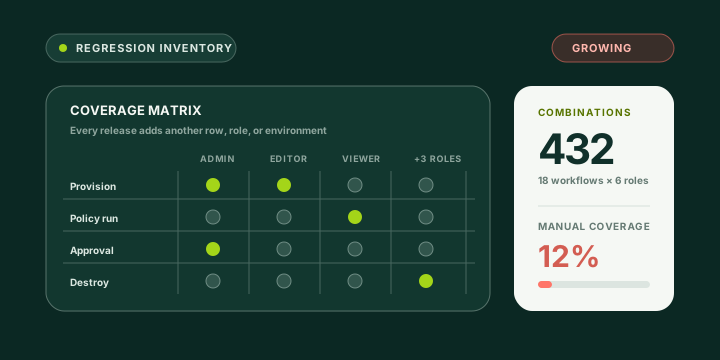
    Every product area adds more workflows, roles, environments, and combinations to recheck.

  3. Warning sign

    Automation is not trusted

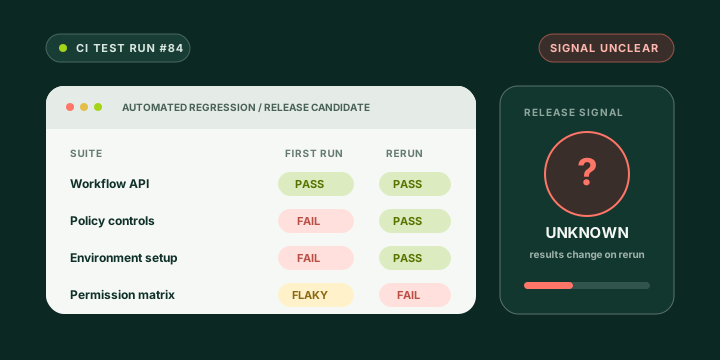
    Tests exist, but their output does not provide dependable evidence for release decisions.

  4. Warning sign

    Connected failures escape isolated checks

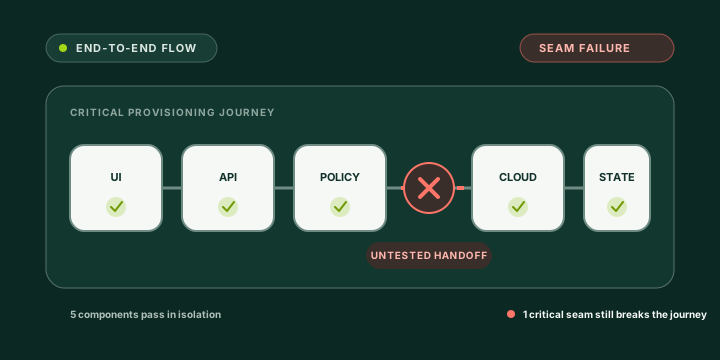
    Important workflows break across UI, API, integration, permissions, policy, and environment seams.

  5. Warning sign

    QA signal arrives too late

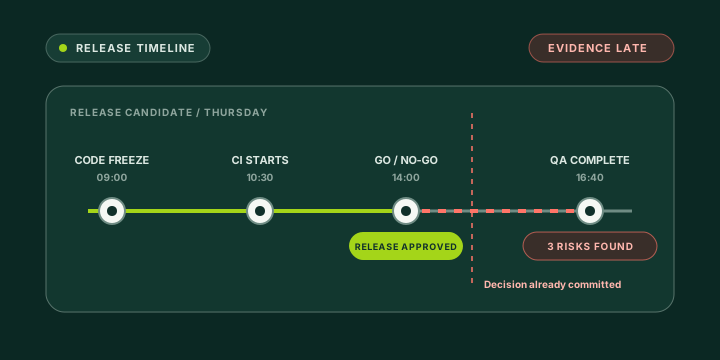
    Findings surface after the team has already committed to a release decision.

Ready to make the bottleneck visible?

Bring Us the Release Bottleneck Creating the Most Uncertainty

We will determine whether it can become a meaningful 14-day implementation scope. If the problem is not suitable for the pilot, we will tell you directly.

NDA before access Least-privilege scope Every asset stays yours No long-term lock-in
Horia Adamov, QA Architect
Your call host

Horia Adamov

QA Architect