

How We Engage Recurring QA operating ownership

Put one accountable QA operating layer behind every release.

AQA runs recurring QA priorities, execution, automation maintenance, regression, and release evidence inside your stack—so your team can ship from a clear signal without building and operating another QA department.

Engagement at a glance

Start with one consequential boundary. Expand only when the evidence earns it.

Model
Recurring managed QA operating ownership
Starting boundary
One consequential product or release-risk surface
Cadence
Integrated with the agreed sprint and release rhythm
Ownership
Client keeps final release authority and agreed AQA-created assets

Independent review profiles

Independent evidence, clearly linked to its source.

Review AQA Masters on the independent platforms below before deciding whether recurring QA ownership belongs in your delivery system.

The expensive status quo

Your releases already have a QA cost. It is hiding in rework, delay, and leadership attention.

The problem is rarely a complete absence of testing. It is recurring work without one accountable owner connecting product risk, execution, automation health, and the release decision.

What keeps happening

Product, Engineering, and QA each hold part of the release picture, but nobody owns the signal end to end.

What managed ownership changes

One managed operating layer connects risk priorities, coverage, execution, and evidence across the agreed boundary.

What keeps happening

Regression expands while critical customer flows still depend on memory, heroics, or late manual checking.

What managed ownership changes

Coverage and execution follow business consequence, with critical-flow protection maintained as the product changes.

What keeps happening

Automation exists, but flaky checks, unclear failures, and deferred maintenance make the signal hard to trust.

What managed ownership changes

Useful controls are implemented, triaged, maintained, and connected to explicit ownership and release decisions.

What keeps happening

Leaders spend release week translating pass rates, incidents, and team opinions into a decision they can defend.

What managed ownership changes

Every review states what was protected, what remains exposed, what evidence supports the conclusion, and who owns the next action.

The managed mechanism

4layers

One accountable system.
Direction, ownership, execution, and technical leverage stay connected.

One managed system. Four accountable layers.

This is an operating model, not four automatic full-time allocations. Role participation, named responsibilities, capacity, and cadence are agreed around the product boundary AQA must operate.

  1. System direction

    QA Architect

    Maintains the quality model: critical flows, risk boundaries, coverage layers, automation direction, AI guardrails, release gates, and the architecture the delivery team can extend.

    Managed layerAllocated and operated according to the agreed recurring scope

  2. Operating ownership

    QA Lead

    Owns the QA rhythm: priorities, coordination, triage, evidence standards, quality metrics, escalation, and release-readiness reviews across the agreed delivery boundary.

    Managed layerAllocated and operated according to the agreed recurring scope

  3. Product execution

    Embedded QE

    Supplies named recurring QA capacity for product learning, test design, execution, regression, defect investigation, and day-to-day integration with the client delivery team.

    Managed layerAllocated and operated according to the agreed recurring scope

  4. Technical leverage

    AI-Augmented QE

    Accelerates approved analysis, implementation, automation maintenance, specialist validation, and evidence preparation under accountable human review.

    Managed layerAllocated and operated according to the agreed recurring scope

The recurring operating cadence

Every cycle connects product risk to a release decision someone can defend.

The exact ceremonies follow the client delivery rhythm. The operating logic stays stable: align the risk, protect what matters, execute and triage, improve the signal, and explain the decision.

  1. Stage : 1

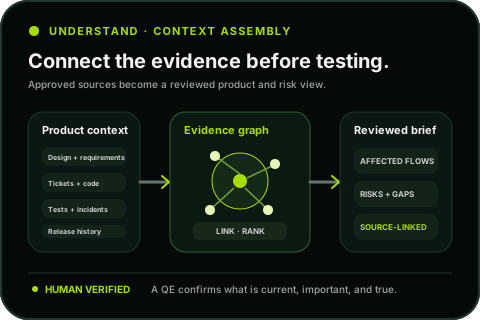
    Align risk and release commitments

    Managed layer

    Start with the customer and business consequence—not a queue of disconnected test tasks.

    AQA reviews the relevant roadmap, changes, incidents, architecture, current controls, and release commitments. The client and AQA agree what deserves protection in the upcoming cycle and which uncertainty must be reduced.

    Activities
    • Release and roadmap risk review
    • Critical-flow and dependency updates
    • Incident and signal review
    • Priority, owner, and success-signal agreement
    Outputs
    • Current risk priorities
    • Agreed execution boundary
    • Named decision owners
    • Visible assumptions and blockers

    Human controlAI may organize approved context. Accountable AQA leadership and the client decision owner approve what matters and what enters the cycle.

    Managed layerAllocated and operated according to the agreed recurring scope

  2. Stage : 2

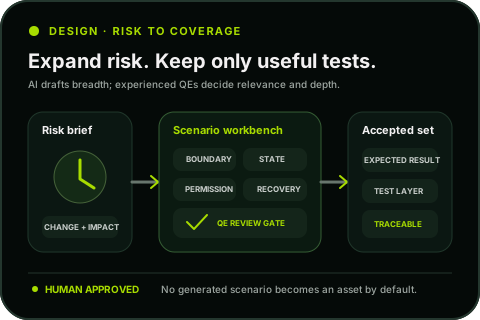
    Design and maintain useful protection

    Managed layer

    Put coverage where a failure would change a customer, revenue, trust, or operational outcome.

    Coverage is designed and revised across the useful layer: exploratory, API, browser, integration, data, accessibility, performance, or other agreed controls. Existing automation is maintained when it supports the decision signal.

    Activities
    • Risk-based scenario design
    • Coverage-layer selection
    • Test-data and environment planning
    • Automation and control maintenance
    Outputs
    • Prioritized coverage
    • Implemented or maintained controls
    • Updated run guidance
    • Known coverage limits

    Human controlAI can expand possibilities and accelerate drafts. Qualified practitioners select, implement, review, and reject work that does not improve dependable signal.

    Managed layerAllocated and operated according to the agreed recurring scope

  3. Stage : 3

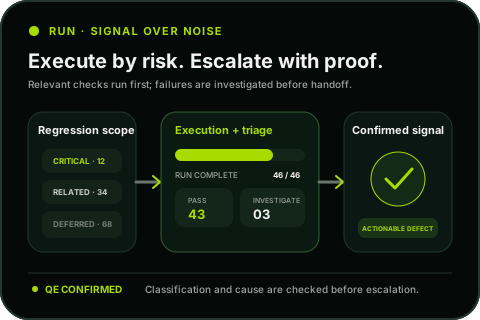
    Execute, investigate, and triage

    Managed layer

    Return evidence Engineering and Product can act on—not another undifferentiated failure list.

    AQA runs the approved work within the available environments and access. Failures are reproduced and classified before escalation so product defects, test defects, environment problems, and missing context do not become the same queue.

    Activities
    • Planned and change-based execution
    • Failure reproduction and classification
    • Defect and blocker triage
    • Targeted exploratory investigation
    Outputs
    • Execution evidence
    • Actionable defects and blockers
    • Cause classification
    • Updated risk and coverage state

    Human controlAI may assist analysis. AQA owns the interpretation and does not present an unverified model conclusion as a product defect.

    Managed layerAllocated and operated according to the agreed recurring scope

  4. Stage : 4

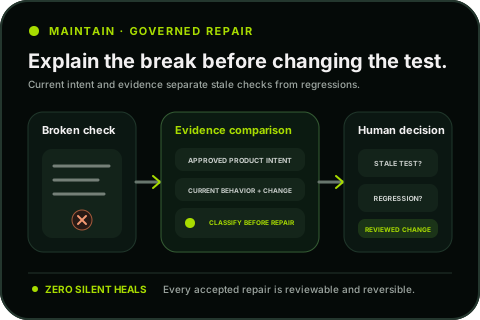
    Improve the signal

    Managed layer

    Make the next release easier to understand than the last one.

    AQA reviews flaky behavior, slow checks, repeated escapes, weak evidence, maintenance debt, and gaps exposed during the cycle. Improvements are prioritized by future decision value rather than raw automation count.

    Activities
    • Flake and failure-pattern review
    • Coverage and maintenance debt review
    • Signal and reporting improvements
    • Ownership and runbook updates
    Outputs
    • Stabilized useful controls
    • Prioritized improvement backlog
    • Updated operating guidance
    • Explicit deferred work

    Human controlSilent AI healing is not treated as maintenance. Changes remain reviewable, attributable, and subject to qualified approval.

    Managed layerAllocated and operated according to the agreed recurring scope

  5. Stage : 5

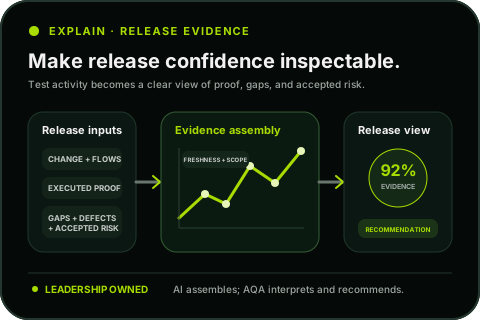
    Issue decision-ready release evidence

    Managed layer

    State what is protected, what remains exposed, and what should happen next.

    AQA assembles tested scope, meaningful failures, blockers, coverage limits, accepted risk, and the recommended next action. The client keeps final release authority; AQA owns making the evidence and uncertainty clear.

    Activities
    • Evidence and remaining-risk review
    • Release recommendation preparation
    • Decision-owner checkpoint
    • Next-cycle priority update
    Outputs
    • Release evidence brief
    • Known-risk and blocker record
    • AQA recommendation
    • Named next actions and owners

    Human controlAI may assemble approved evidence. AQA leadership owns the conclusion and the client owns the final product and release decision.

    Managed layerAllocated and operated according to the agreed recurring scope

Time to useful signal

Useful release evidence first. Broader ownership only after it earns its place.

Managed QA Delivery should reduce uncertainty in stages. It should not pretend an entire product surface becomes dependable on an arbitrary date.

  1. First 14 days

    Establish the baseline

    Map critical context, current controls, ownership gaps, signal quality, and the most useful first delivery priorities.

  2. Days 15–30

    Install the cadence

    Run the agreed ceremonies, execute the first priorities, issue evidence, and make responsibilities work through normal delivery.

  3. Days 31–60

    Strengthen protection

    Maintain useful controls, reduce recurring noise, improve coverage around observed risk, and make release evidence easier to act on.

  4. Days 61–90

    Review the boundary

    Expand proven ownership, hold the current scope, change the model, or prepare handover based on observed delivery evidence.

The operating value stack

See the system AQA operates—not a report of hours consumed.

The exact assets follow the agreed scope. Every item must improve recurring execution, maintenance, or a decision the client needs to make.

01Direction and ownership

Keep risk, priorities, and responsibilities current.

The operating model connects business consequence to QA work and makes ownership visible across the cycle.

Operating assets

2 operating assets

Living risk and critical-flow model

Maintained according to the agreed cadence.

Customer-critical journeys, dependencies, failure consequences, current controls, ownership, and meaningful gaps kept current across the agreed product boundary.

Evidence
Linked to approved product context, observed behavior, incidents, current changes, and delivery conditions.
  • Maintained
  • Client-owned
  • Human-reviewed
  • Source-linked

QA operating backlog and ownership record

Recurring operating asset.

Risk-ranked work, decision value, dependencies, owners, deferred items, and the reason each priority belongs in the delivery system.

Evidence
Updated through planning, triage, evidence reviews, and explicit client decisions.
  • Maintained
  • Client-owned
  • Human-reviewed

02Execution and maintenance

Build protection that stays useful as the product changes.

AQA executes the agreed work, investigates failures, and maintains the controls that support recurring delivery.

Operating assets

2 delivery assets

Implemented and maintained quality controls

Depth follows the agreed delivery scope.

Approved tests, automation, fixtures, integrations, specialist checks, configurations, or evidence workflows created and maintained in the client context.

Evidence
Implementation location, execution result, maintenance state, constraints, and ownership remain visible.
  • Implemented
  • Maintained
  • Client-owned
  • Human-reviewed
  • Source-linked

Execution, failure, and triage record

Produced at the agreed execution cadence.

What ran, passed, failed, blocked, or could not be tested—plus defect, test, environment, data, or context classification.

Evidence
Grounded in available environments, source evidence, reproduction, and explicit uncertainty.
  • Maintained
  • Client-owned
  • Human-reviewed
  • Source-linked

03Evidence and continuity

Make release and continuation decisions reviewable.

Leadership receives a concise signal while the team retains the assets and guidance needed for continuity.

Operating assets

2 decision assets

Decision-ready release evidence brief

Produced at agreed release checkpoints.

Tested scope, meaningful failures, blockers, known gaps, accepted risk, and the AQA recommendation in one reviewable release signal.

Evidence
Every material conclusion connects to available evidence or is labeled as uncertainty.
  • Client-owned
  • Human-reviewed
  • Source-linked

Runbook, asset inventory, and handover record

Maintained for continuity and exit readiness.

How to run, interpret, troubleshoot, maintain, and transfer the agreed operating assets without hidden dependency on AQA.

Evidence
Reflects the delivered assets, known failure modes, ownership boundaries, and current operating cadence.
  • Maintained
  • Client-owned
  • Human-reviewed

Choose the right engagement

Choose how much QA ownership your team actually needs.

The difference is not team size or a feature list. It is the boundary AQA owns after work begins. Start with focused proof, add missing capability around your team, or hand AQA the recurring delivery layer.

01 / Prove the model

14-Day AI-Augmented QA Pilot

Choose when
Choose this when the release problem is real but the right longer-term QA model is not yet proven.
AQA owns
One critical flow, one success signal, and the agreed 14-day implementation and evidence boundary.
Your team keeps
The delivered assets, evidence, remaining-risk record, and the decision to stop, extend, or scale.

02 / Strengthen your team

QA Leadership & Enablement

Choose when
Choose this when your existing team remains responsible for delivery but needs architecture, leadership, or specialist technical leverage.
AQA owns
The selected QA Architect, QA Lead, or AI-Augmented QE capability boundary and its agreed outcomes.
Your team keeps
Day-to-day QA delivery, product context, final release authority, and agreed AQA-created assets.

Commercial boundary

Recurring ownership should be explicit before recurring delivery begins.

The fit call defines the first product boundary, role allocation, named responsibilities, capacity, cadence, evidence checkpoints, ownership, and continuation terms before AQA enters the delivery rhythm.

Agreement at a glance

Model
Recurring managed QA operating ownership inside an agreed client delivery boundary
Starting scope
One consequential product surface, release constraint, or risk boundary
Team allocation
Role participation, named responsibilities, capacity, and availability defined in the agreement
Cadence
Planning, execution, triage, maintenance, and evidence reviews aligned to the agreed delivery rhythm
AI
Client-approved use with human review and accountable QA judgment
Ownership
Client keeps final release authority and agreed AQA-created assets
Continuation
Scope changes and continuation follow explicit review—not fabricated urgency or silent expansion

Responsibilities and guardrails

Know what each side owns before recurring delivery begins.

  1. AQA commitment

    AQA responsibility

    • Operate the agreed QA delivery boundary and recurring cadence
    • Supply the role participation, named responsibilities, and capacity defined in the agreement
    • Execute, investigate, maintain, and report the agreed work with visible evidence and limits
    • Keep operating assets, guidance, and handover records current within scope
  2. Your role

    Client participation

    • Name a Product or Engineering decision owner and keep product priorities visible
    • Provide least-privilege access, usable environments, and timely product context
    • Review risk, evidence, release recommendations, and operating changes at agreed checkpoints
    • Keep final product, risk-acceptance, and release authority
  3. Scope guardrails

    Not included by default

    • Unlimited testing, unbounded product coverage, or four automatic full-time allocations
    • A zero-defect promise or autonomous AI quality and release decisions
    • Instant whole-product transformation without a proven starting boundary
    • Transfer of pre-existing AQA or third-party ownership rights

Decision value

The buyer receives recurring operating work and decision evidence—not a promise that activity alone equals confidence.

Ownership

Agreed AQA-created assets remain available to the client. Runbooks and an asset inventory reduce hidden dependency and support handover.

Fit filter

Built for teams that need recurring QA ownership—not another advisory layer.

The model works when important QA work must continue every cycle and the client is ready to make product context, access, and decisions available.

Wrong engagement

Wrong engagement

Strong fit

Strong fit

  1. The only requirement is the cheapest available tester hours

    A recurring release or regression problem consumes Product and Engineering attention

  2. The current team needs one missing senior capability but keeps recurring delivery ownership

    AQA must operate execution, maintenance, and evidence—not only recommend improvements

  3. The product cannot provide context, access, environments, or a decision owner

    One consequential product or risk boundary can define the starting scope

  4. The expectation is unlimited coverage or a zero-defect guarantee

    A client decision owner can participate in priority and evidence reviews

  5. AI is expected to make autonomous product quality or release decisions

    Scoped access and usable environments can support recurring delivery

  6. The buyer wants an unproven long-term model without starting from evidence

    The team values client-owned assets, visible evidence, and an explicit handover path

Questions before ownership

Direct answers about delivery, capacity, evidence, and control.

The engagement should be easy to reject when recurring ownership is unnecessary and easy to understand when QA work must keep happening every release.

Recurring ownershipNamed capacityAI governanceClient-owned assetsRelease authority

Traditional outsourcing often sells interchangeable tester hours. Managed QA Delivery defines an operating boundary AQA owns: risk priorities, execution, maintenance, triage, evidence, and the cadence connecting them. Role allocation and capacity are explicit, while the client keeps product and release authority.

Start with the recurring constraint

Bring the release path that keeps costing your team attention.

Use a 30-minute fit call to map the recurring QA ownership gap, the first product boundary, and whether the right next move is the Pilot, QA Leadership & Enablement, Managed QA Delivery, or no AQA engagement.

NDA before access Least-privilege scope Every asset stays yours No long-term lock-in
Horia Adamov, QA Architect
Your call host

Horia Adamov

QA Architect