

How many release meetings have ended with the same carefully worded conclusion: “We think it is ready”? The test results look acceptable, the remaining defects appear manageable, and everyone has a reason to move forward, yet nobody can say with complete confidence what may have been missed. When something important later fails in front of customers, the team inherits more than another bug because it must also ask whether its QA process can still keep pace with the product.
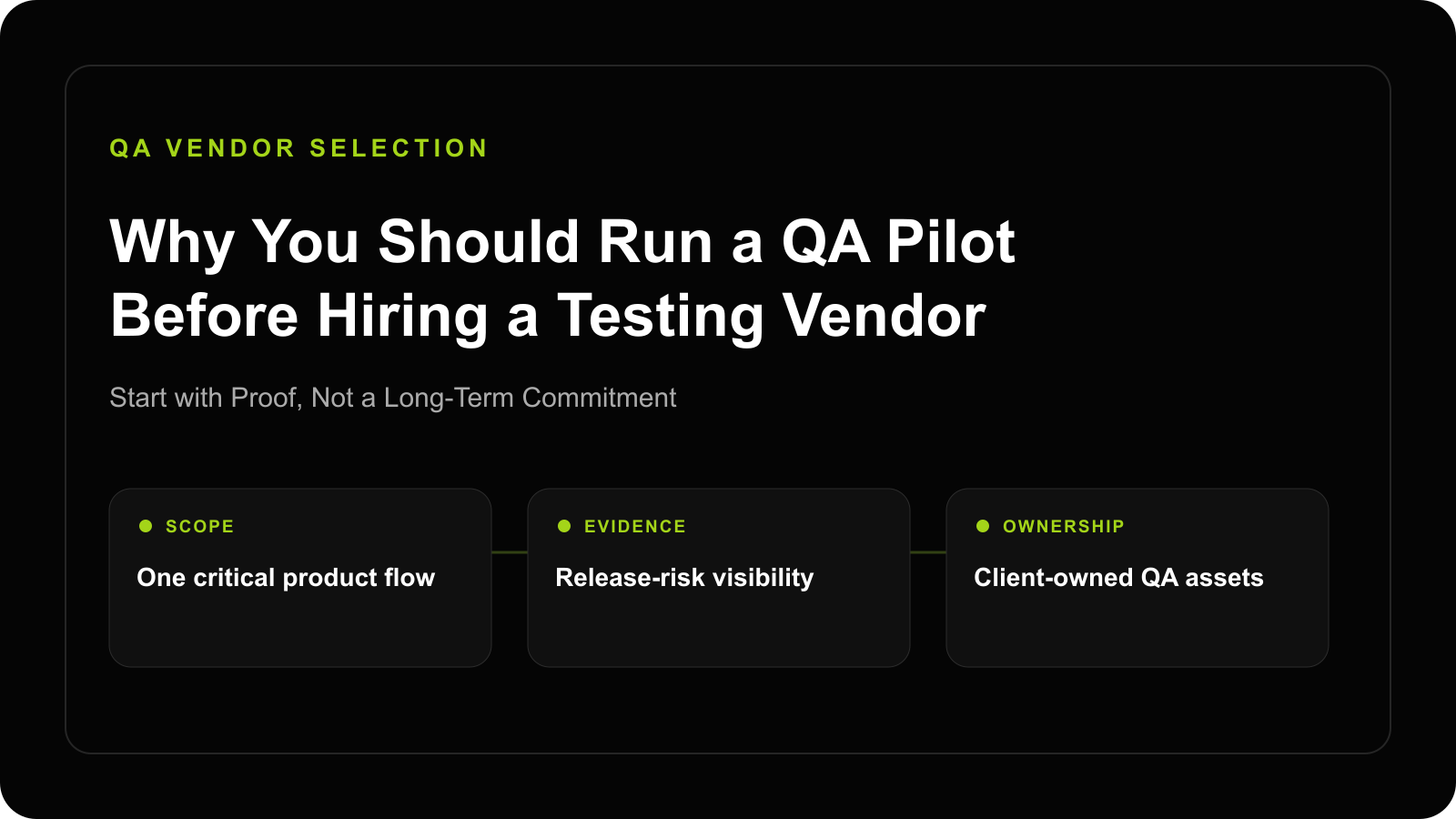
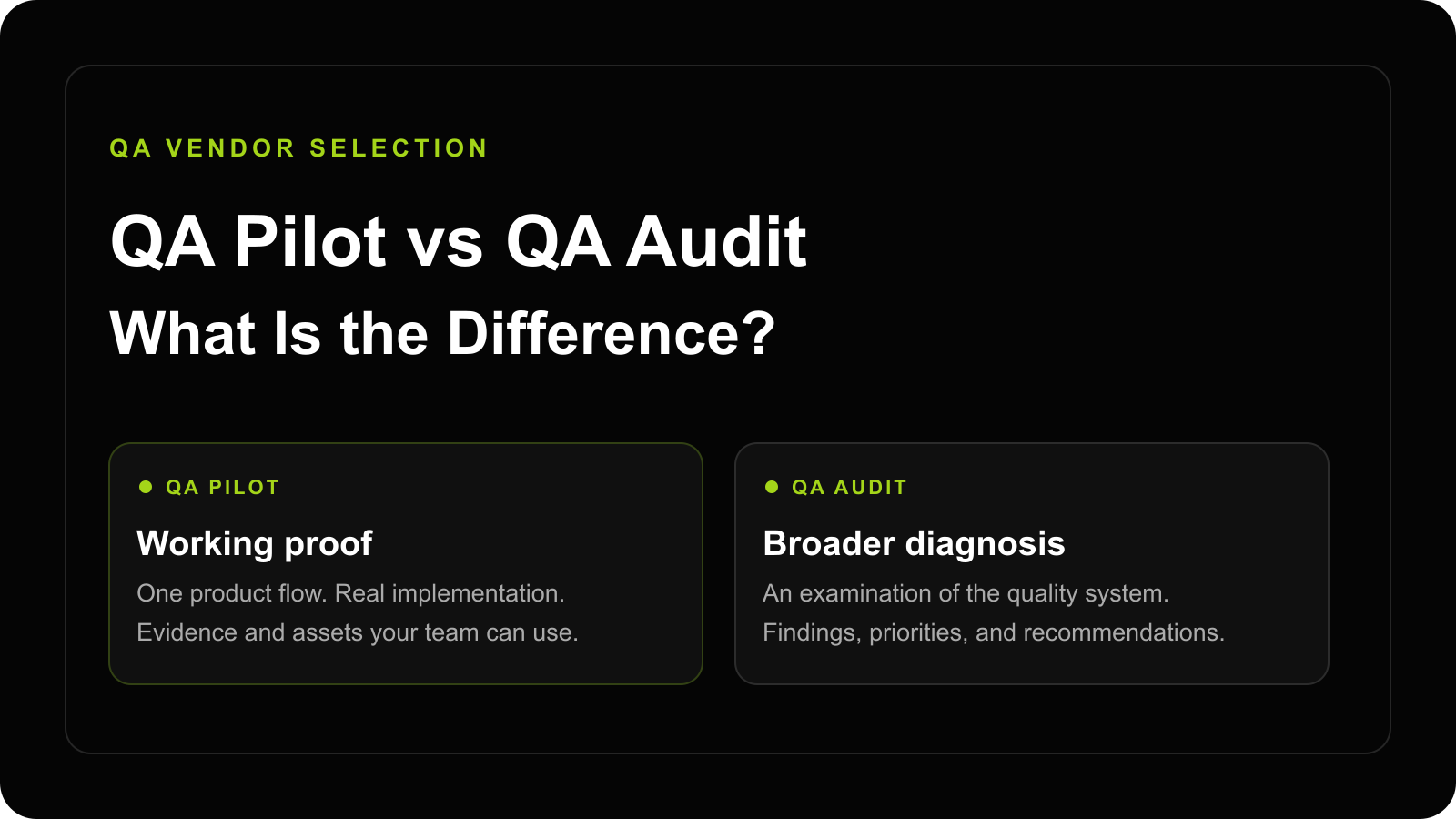
This is often when a QA pilot or a QA audit enters the conversation. A QA pilot works inside a carefully selected product area to demonstrate what can be improved through real execution, while a QA audit examines the wider quality system to reveal where problems originate and what should change.
The difficult part is not understanding what each option promises, but deciding whether the team needs a broader explanation of the problem or a focused piece of work it can examine, keep, and use to justify the next step.
30-Second Summary
TL;DR: A QA pilot creates working proof inside the product and shows whether an approach deserves to scale, while a QA audit is most useful when the problem is still too broad or unclear for implementation to begin.
- A QA pilot turns the provider’s approach into completed work inside a defined product area, making it particularly valuable when the problem is already visible and the company wants evidence before approving a larger engagement.
- A QA audit examines the wider quality system when recurring defects, unreliable automation, or inconsistent practices cannot be traced to one clear cause, although its findings still need to be converted into implementation afterward.
- The two engagements leave the client with different outcomes, since a pilot should produce reviewable evidence and usable assets, whereas an audit usually delivers findings, priorities, and recommendations for future action.
- The tradeoff is mostly about scope: a pilot creates deeper proof within one limited product area, while an audit examines more of the organization but may not show whether its recommendations can work in practice.
- A QA pilot and a QA audit can support each other when the situation genuinely requires both, with the audit identifying what deserves attention and the pilot proving whether the proposed improvement produces a meaningful result.
What Matters Most: When the team can already identify the problem, working proof will usually be more valuable than additional analysis, while an audit becomes useful when acting without a broader diagnosis could send the company toward the wrong solution.
What Is a QA Pilot?
A QA pilot begins with a deliberate choice: instead of trying to improve the entire QA process at once, the team selects one business critical product flow where the problem is real and the outcome matters. That boundary gives the work meaning, because the provider enters the actual product and existing delivery stack, while both sides agree on what success should look like before the work begins.
From there, the pilot follows the product rather than a generic checklist. The team learns the context behind the selected flow, identifies the gaps that deserve attention, and implements the most useful improvements the scope can support. The client does not have to imagine how the approach might perform after a larger contract because it can observe how the provider works when real code, constraints, and engineering priorities enter the picture.
By the end, the value should not live inside a presentation. The client should keep reviewable evidence, usable assets, and a clear view of what remains unresolved, making it easier to decide whether the approach has earned the right to stop, continue, or expand.
What Is a QA Audit?
A QA audit begins when the problem refuses to stay in one place. Defects keep returning, automation exists but its results are difficult to trust, and different teams have developed their own way of deciding what is ready. Instead of entering one product flow to make an immediate change, the audit steps back and examines the quality system that allowed these patterns to develop.
The auditor follows the way work moves from an idea to the hands of the customer, comparing documented practices with what actually happens during development and testing. Technical evidence is combined with conversations across the team, revealing the gaps between the process people believe they have and the one they use every day.
By the end, the company should have an independent view of what is working, what is creating unnecessary friction, and which improvements deserve attention first. A strong QA audit can replace assumptions with direction, but its value depends on what happens next, because findings and recommendations do not improve the product until someone turns them into working change.
QA Pilot vs QA Audit: Key Differences
A QA pilot and a QA audit can begin with the same concern, but they create different forms of value. One puts a possible solution to work inside the product, while the other looks across the quality system to understand what is helping or holding it back.
| QA Pilot | QA Audit | |
|---|---|---|
| Primary purpose | Prove how a QA approach performs through real work | Understand the condition of the existing QA system |
| Typical scope | One business critical product flow or clearly defined problem | Multiple processes, teams, tools, and testing practices |
| How the work happens | Testing and improvements are carried out inside the existing product stack | Evidence is gathered through technical reviews, documentation, and team discussions |
| What the client receives | Reviewable evidence, usable assets, and a practical next decision | Findings, priorities, and recommendations for improvement |
| When change becomes visible | During the engagement, as improvements are implemented and tested | After the organization begins acting on the recommendations |
| Best fit | The problem is visible, but the team wants proof before making a larger commitment | The causes remain unclear or appear across the wider QA organization |
| Main trade off | The limited scope cannot represent every part of the product or organization | A broad diagnosis may not include the implementation needed to create change |
A recommendation can be completely right and still change nothing, because the distance between understanding what should improve and proving that the improvement works is often where QA initiatives lose momentum. A QA audit can provide a clear diagnosis and sensible priorities, but the organization must still decide who will implement them and whether they will produce the expected result.
A QA pilot shortens that distance by putting the proposed approach to work while the engagement is still active. The provider must understand a real product flow, make decisions within the client’s constraints, and leave behind work the team can examine and use. When the underlying problem remains unclear, an audit can provide the direction the organization needs, but when the problem is already visible, working proof will usually carry more weight than another recommendation.
When Should You Choose a QA Pilot?
The proposal looks convincing because the delivery model is carefully explained, the case studies appear relevant, and everyone on the call seems to understand the problem, yet one important question remains unanswered: what happens when this team enters our product and has to make its approach work under our constraints?
That question becomes more important when the company already knows where the pressure is building. A critical customer journey may be breaking too often, automation may exist without providing dependable feedback, or AI assisted development may be producing change faster than the current testing process can absorb. The team does not need another explanation of why the problem matters because it needs to see whether a proposed approach can actually improve it.
A QA pilot creates that moment of truth without asking the company to hand over the entire quality operation. One important product flow is placed inside a controlled scope, meaningful progress is defined before the work begins, and the provider has to turn its promises into decisions, testing, and usable results within the real environment.
This is why a pilot becomes valuable before a larger commitment, because it gives the buyer a chance to observe how the provider learns, communicates, adapts, and delivers when the polished slides are gone and only the product remains.
When Should You Choose a QA Audit?
The testing dashboard may show steady progress while customer complaints, production defects, and repeated rework tell a different story. Each team can explain its own part of the process, but those explanations do not form a complete picture, leaving leadership with plenty of activity to measure and very little certainty about what should change first.
A QA audit becomes useful before the company makes a decision that would be expensive to reverse, such as rebuilding its automation approach, changing how quality is owned, or replacing an existing testing partner. By establishing a shared view of the current situation, the audit gives technical and business leaders a more reliable basis for deciding where further investment is justified.
The strongest reason to choose an audit is therefore not that the organization wants more documentation, but that acting on the wrong explanation could cost more than taking the time to investigate it properly.
Make the Problem Smaller Before the Contract Gets Bigger
Before choosing, put the proposals aside and ask your team a more practical question: “If a QA provider joined us tomorrow, which real product problem would we want them to work on first?” If nobody can identify one, a broader QA audit may be necessary, but if the answer comes quickly, the following questions will reveal whether a QA pilot can provide the evidence needed before a larger commitment.
Can we define one problem that matters enough to test now?
A useful pilot needs a clear boundary, such as an unreliable customer journey, weak automation feedback, or a product area where testing can no longer keep pace with development. The problem does not need to be simple, but it must be specific enough for both sides to recognize meaningful progress.
Will the provider work inside the real product?
Ask whether the work will happen within your existing stack and engineering workflow or inside a separate demonstration environment. A pilot becomes more valuable when the proposed approach has to perform against the same code, constraints, and priorities that the internal team faces every day.
What will we be able to review and keep?
The engagement should leave more than observations and a final presentation. Clarify whether your team will retain the testing evidence, documentation, automation, configurations, and other usable assets created during the pilot.
Will the results support a larger decision?
A QA pilot should help the company evaluate more than the technical output because it also reveals how the provider learns the product, communicates with the team, and responds when the original plan meets reality. By the end, the buyer should have enough evidence to decide whether the collaboration should stop, continue, or expand.
Promises End Where the Pilot Begins
Running a pilot is not the same as validating a decision, because two busy weeks can still leave both sides with different ideas of what was achieved. A useful QA pilot begins with one clear question: “If this approach is right for our product, what should we be able to see, use, or decide by the end?”
Before the work begins, the team should document the current condition of the selected area and agree on what meaningful improvement would look like. The evaluation should consider more than test cases and defect counts, because the way the provider understands context, handles unexpected findings, and works with the internal team is part of what the pilot is meant to prove.
This is the thinking behind AQA Masters and its 14-Day AI-Augmented QA Pilot, which applies the model to one business critical flow and leaves the client with implemented improvements, reviewable evidence, and owned assets. By the end, the company should have enough proof to stop, adjust, or expand without making a larger commitment based on promises alone.