

Disclaimer: This article is based on publicly available information from company websites, independent review platforms, published case studies, and industry sources. The rankings reflect our editorial assessment and are not an audited evaluation. Readers should conduct their own due diligence before selecting a software testing provider.
Choosing a software testing company in 2026 is difficult for one simple reason: at first glance, most providers look almost identical. They offer experienced engineers, test automation, AI-powered workflows, and faster delivery, but a familiar list of services does not explain how they will improve the way your product is tested.
The right software testing partner is not always the company with the biggest team or the most familiar logo. This list brings together the top 10 specialized software testing providers whose QA work is supported by credible client reviews, published case studies, and an active track record in the market. Each company addresses a different type of testing need, making this comparison more useful than a ranking based on size or brand recognition alone.
If you are a CTO, Head of QA, or Engineering Lead evaluating software testing partners in 2026, this comparison will help you build a shortlist around your product, team, and testing needs.
30-Second Summary
TL;DR Looking for a quick comparison? Use this table to find the provider that best matches your product and QA needs.
| Company | Recommended for |
|---|---|
| 1. AQA Masters | Engineering teams using AI heavily to accelerate product development and operating where a poor release is simply not an option. |
| 2. QualityLogic | US organizations that prefer onshore QA support for accessibility or interoperability testing. |
| 3. QAMadness | Product teams looking for flexible QA support that can grow into a dedicated team if needed. |
| 4. Mindful QA | US teams looking for testers on demand without a long term outsourcing commitment. |
| 5. TestDevLab | Products that may benefit from specialist laboratories, physical devices, or independent testing infrastructure. |
| 6. TestMatick | Teams seeking general software testing support for a defined project or an ongoing engagement. |
| 7. QATestLab | Organizations that prefer structured testing processes, detailed documentation, and longer term support. |
| 8. QAlified | Regulated or public facing products where accessibility, security, and compliance require additional attention. |
| 9. QAwerk | Consumer product teams that prefer a compact senior team with an exploratory testing approach. |
| 10. KiwiQA | Organizations interested in formalizing QA through clearer governance or a Test Center of Excellence. |
How we selected the best software testing companies for 2026
Our shortlist is built around five criteria that distinguish credible QA specialists from the rest.
| Criteria | What we considered |
|---|---|
| QA-first specialization | We prioritized providers whose primary business is quality assurance and software testing, rather than general technology companies that include QA within a much broader service portfolio. |
| Current delivery record | We looked for recent client work, reviews, case studies, and service activity showing that the company is delivering in 2025–2026, not relying mainly on an older reputation. |
| Independent client validation | Consistent reviews on independent platforms such as G2, GoodFirms, and Clutch carried more weight than testimonials or awards promoted only through the company’s own channels. |
| Commercial and delivery transparency | We considered how clearly each provider explains its engagement models, working process, pricing approach, and what a client can expect once the collaboration begins. |
| Measurable case study evidence | Strong case studies connect a real client problem with the work delivered and a specific, measurable result. General success stories without supporting facts were treated as marketing claims. |
No company on this list will be the perfect fit for every team, which is completely normal. Your technical environment, current testing process, and internal team all shape the decision. Compare those needs with what each company does best, then focus on the providers that feel like the most practical match.
1. AQA Masters
Headquarters: Bucharest, Romania (global delivery)
Recommended for: Engineering teams building technically complex products, using AI to increase development speed, and operating where a poor release can damage revenue, customer trust, or critical operations.
AQA Masters is a full service QA and software testing company covering the complete testing lifecycle. Its main specialization is AI-Augmented QA, a practical system in which AI helps uncover risk, improve coverage, and accelerate testing while experienced QA professionals remain responsible for what can be trusted and what is ready to ship. Its specialists work as part of the client’s product and engineering workflow through an Embedded QA system that connects testing strategy with day-to-day execution and release decisions. The work is implemented inside the client’s existing stack, allowing the client to retain control of everything created during the engagement.
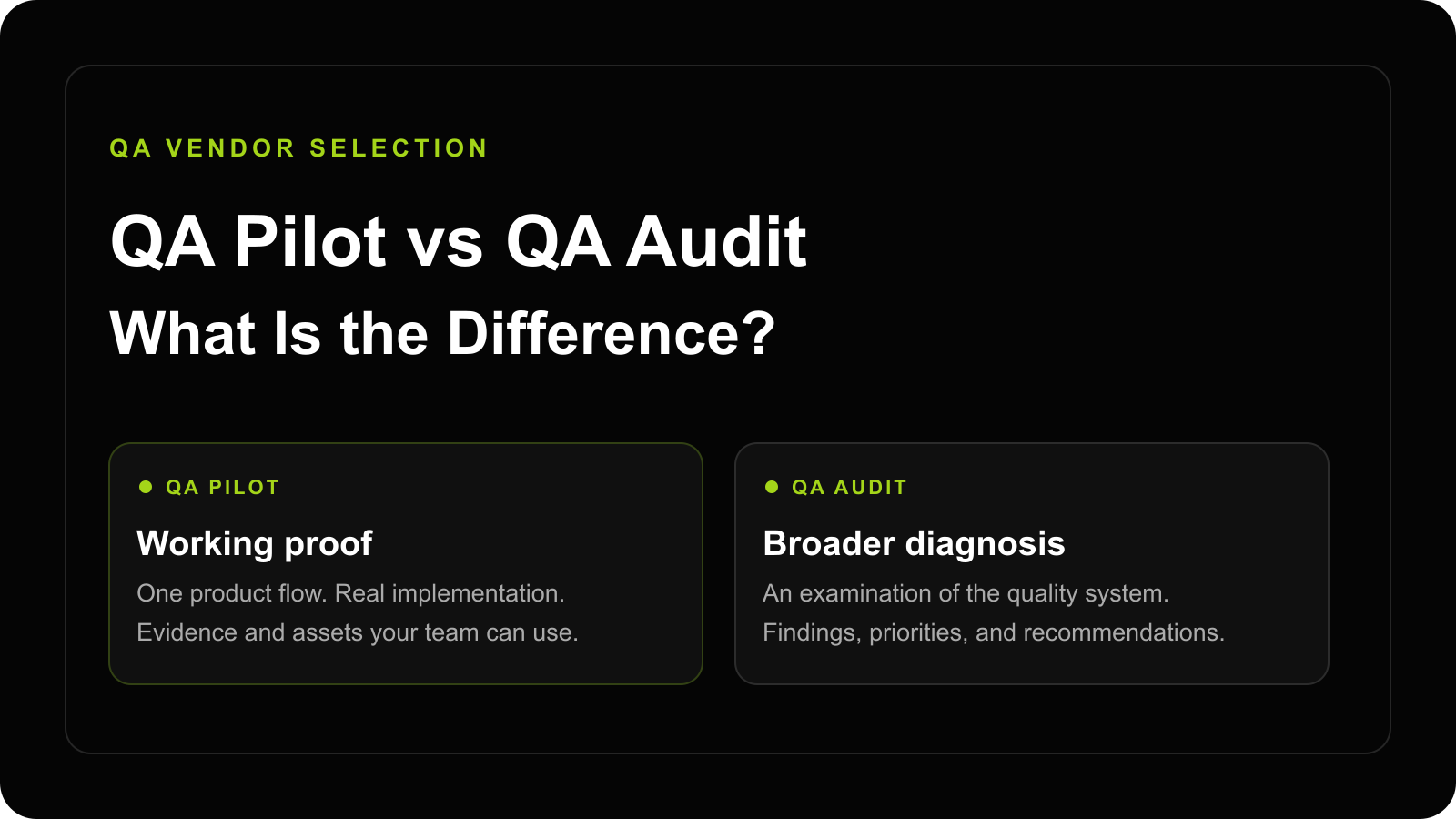
Key consideration: AQA Masters is designed for companies whose use of AI has increased delivery speed faster than their QA process can safely follow. The 14-Day AI-Augmented QA Pilot focuses on one high-stakes release problem, delivers working proof inside the real product, and expands only when the results justify it.
2. QualityLogic
Headquarters: Idaho, United States
Recommended for: Engineering teams in the United States that prefer onshore QA support and need a flexible testing partner for software platforms, digital accessibility, or specialized interoperability work.
QualityLogic is a software testing company with more than 30 years of experience in software testing, system testing, and test tool development. Its work covers manual and automated testing for web, mobile, and other software platforms, with additional expertise in digital accessibility, interoperability, and testing based on industry standards. The company can support individual projects or provide dedicated QA teams that integrate with an existing development process.
Key consideration: QualityLogic delivers its core services through teams and testing laboratories based in the United States, while hybrid arrangements combining onshore management with international testers are also available.
3. QAMadness
Headquarters: Warsaw, Poland (global remote delivery)
Recommended for: Product teams looking for flexible QA support that can begin with a specific testing assignment and expand into a dedicated team when the workload becomes continuous.
QAMadness is an independent software testing company that supports digital products through manual testing, automation, and QA consulting. Its engineers can complete a focused testing assignment or join an existing development workflow as a dedicated team, depending on the amount and continuity of work required. The company also supports more specialized quality needs, including AI product validation, and uses tools supported by AI for selected tasks while keeping engineers responsible for the testing process.
Key consideration: Under its dedicated team model, management of the daily QA work remains with the client, while QAMadness handles staffing and administration.
4. Mindful QA
Headquarters: California, United States (entire team based in the United States)
Recommended for: Product teams in the United States that want experienced testers available when needed and prefer a flexible engagement without a long term outsourcing contract.
Mindful QA is a boutique software testing company whose entire staff is located in the United States, with testers working across every American time zone. It tests websites, mobile applications, and other software through an on demand model that can support anything from a focused testing round to ongoing QA, beginning with a minimum engagement of 20 hours and no long term commitment. Social responsibility is also part of the company’s identity. Mindful QA is carbon neutral and donates 10 percent of its profits to nonprofit organizations and charities.
Key consideration: Mindful QA is a smaller provider built around flexible engagements, making it better suited to teams that value direct collaboration and adjustable testing support.
5. TestDevLab
Headquarters: Riga, Latvia (global delivery)
Recommended for: Engineering organizations whose products require specialized testing infrastructure or an independent evaluation layer beyond what their internal QA process can provide.
TestDevLab is a software quality company founded in 2011 by two former Skype engineers. Its engagements range from focused QA assessments to individual testing projects and embedded teams, allowing clients to choose how closely the company works with their engineering organization. Alongside conventional software testing, TestDevLab has developed specialist laboratories and a fleet of more than 5,000 physical devices, while expanding its capabilities into AI product evaluation and AI augmented testing.
Key consideration: TestDevLab’s specialist infrastructure and broad testing capabilities are most relevant for technically demanding products. Teams with more focused QA needs may not require the same level of support.
6. TestMatick
Headquarters: New York, United States
Recommended for: Product teams that need flexible QA support, either for a clearly defined testing project or as an ongoing extension of their internal team.
TestMatick is a software testing company founded in 2009. It provides manual and automated testing for web, mobile, and enterprise software, with engagement models that support both projects with a fixed scope and longer dedicated team arrangements. Its broad portfolio enables the company to support different stages of the development process, while its AI testing services focus on evaluating the behavior and reliability of applications that use artificial intelligence.
Key consideration: TestMatick is positioned as a general purpose testing provider, making it most suitable for companies that already understand which parts of their QA process they want to outsource.
7. QATestLab
Headquarters: Nicosia, Cyprus
Recommended for: Organizations that value established testing processes, detailed documentation, and a provider with its own system for training and developing QA specialists.
QATestLab is an independent software testing company with more than 22 years of experience. Its approach places considerable emphasis on planning, transparent reporting, and maintaining a structured testing process throughout the product lifecycle. The company also operates a Training Center that has trained more than 40,000 students and collaborated with 15 universities, supporting its internal recruitment and continuous learning programs.
Key consideration: QATestLab offers several cooperation models, but its Dedicated Team option is primarily structured for longer projects with a consistent testing workload.
8. QAlified
Headquarters: Montevideo, Uruguay
Recommended for: Organizations developing public facing or regulated software where accessibility, security, and compliance are important parts of product quality.
QAlified grew out of GeneXus Consulting as its testing and quality assurance division developed into an independent specialist. Its work combines established software testing practices with a particular focus on security and accessibility, using internationally recognized standards for products operating in more demanding environments. The company also maintains a visible connection to the testing community in Uruguay and the wider region, which remains an important part of its identity.
Key consideration: QAlified works across several industries, but its suitability will depend on the standards and domain knowledge required by each product.
9. QAwerk
Headquarters: Kyiv, Ukraine
Recommended for: Product teams building consumer facing software that value practical exploratory testing and direct access to experienced testers.
QAwerk is a software testing company founded in Ukraine in 2015, with a compact team of more than 30 senior QA engineers. One of the most distinctive parts of its company culture is Bug Crawl, a weekly initiative through which its engineers test selected applications and services at no cost and publish their findings for developers. As of July 2026, the initiative reports more than 1,000 products tested and over 5,800 bugs identified, while also giving QAwerk’s engineers a practical way to develop their skills outside client projects.
Key consideration: QAwerk presents itself as a compact senior team, so companies planning a large or rapidly expanding testing program should confirm team availability and scaling requirements early.
10. KiwiQA
Location: India (with international offices)
Recommended for: Organizations looking to formalize an established testing function through clearer strategy, governance, or a dedicated Test Center of Excellence.
KiwiQA is a software testing company with operations in India, founded in 2009. Alongside its testing services, the company provides Test Center consulting intended to help organizations assess their existing QA capabilities and establish more structured operating models. Its approach includes proprietary methods for designing test cases and internally developed automation frameworks. KiwiQA also reports ISO certifications covering quality management, information security, and privacy.
Key consideration: KiwiQA positions itself as a complete testing provider with a broad service portfolio, so buyers should evaluate its suitability around the specific specialization and engagement model their program requires.
How to choose the right software testing company in 2026
The right software testing company is not necessarily the one offering the most services. It is the partner that understands your product risks, fits the way your engineering team works, and can demonstrate value before the engagement grows. Four questions can help you identify the best fit.
What would a poor release cost your company?
Begin with the consequences of failure. A defect in an internal tool carries a different level of risk from one affecting revenue, customer data, essential operations, or a public facing product.
Teams using AI to develop software faster need a QA partner that can bring similar speed into testing without removing human judgment from release decisions. AQA Masters is particularly relevant in this situation. QualityLogic and QAlified may be better suited to accessibility or compliance driven products, while TestDevLab is a practical option when specialized testing infrastructure is required.
How established is your internal QA function?
Companies without internal QA leadership usually need a partner capable of shaping the testing strategy and taking responsibility for its implementation. Teams with an established QA function may only need additional capacity or a particular specialization.
AQA Masters provides embedded QA leadership through a QA Architect and QA Lead who work within the existing engineering environment. More flexible testing capacity can be found through providers such as Mindful QA, QAMadness, or TestMatick.
How quickly is your product changing?
The faster a product evolves, the more closely QA must work with engineering. This becomes especially important when AI helps developers create and modify software faster than the existing testing process can safely support.
Fast moving products generally benefit from an embedded partner that can continuously adjust coverage and automation around changing risks. Products with a stable roadmap or a clearly defined testing requirement may be better suited to a project based engagement.
Can the provider prove its value before you scale?
Client reviews and case studies can support a shortlist, but they cannot show how a provider will perform inside your product and technology stack. Before making a larger commitment, ask what the company can deliver during the first few weeks and how the results will be evaluated.
A credible QA partner should be able to turn its claims into visible work, giving your team enough evidence to decide whether the engagement should continue.
Choose the working model, not only the company
A capable provider can still be the wrong partner if its way of working does not fit your engineering team. Clarify who will own the testing direction, how closely QA will work with developers, and what must improve for the engagement to be considered successful.
For companies whose development speed has increased through AI, AQA Masters implements an AI-Augmented QA system inside the client’s existing environment. Its 14-Day AI-Augmented QA Pilot applies that approach to one real release problem, allowing the client to evaluate working evidence before considering a broader partnership.