



Artificial intelligence is changing the speed at which software is created. Development teams can now generate, review, and update code faster, but this acceleration also increases the amount of work that must be verified before it reaches users. The shift is already widespread: Google Cloud’s 2025 DORA research found that 90% of technology professionals use AI at work, while more than 80% believe it has improved their productivity. (Google Cloud)
For product teams, the challenge is keeping quality aligned with this new pace. Manual testing and traditional automation remain essential, but relying on them in the same way as before can lead to longer regression cycles, hidden coverage gaps, and greater uncertainty around releases. This guide explores how QA is evolving, where AI can make a practical difference, and why human expertise remains central to the process.
30-Second Summary
TL;DR: AI-Augmented QA can make testing faster, broader, and more effective, but only when AI strengthens a clear QA process instead of replacing judgment with more automated output.
- AI is already becoming part of everyday QA work. Teams are using it to review requirements, suggest test scenarios, draft automation, prioritize regression, and investigate failures often before a shared process has been defined.
- More tests do not automatically create safer releases. AI creates real value when it reduces repetitive work, strengthens critical-flow coverage, and helps teams understand where release risk still exists.
- AI can scale weak decisions as quickly as strong ones. Generated tests may validate the wrong result, rely on invented assumptions, or create false confidence. Convincing output is not the same as trustworthy evidence.
- Proof should come before scale. Start with one important QA problem, establish the current baseline, run a focused AI-Augmented QA Pilot, and expand only when the improvement becomes visible.
- QA engineers will lead the system, not compete with it. AI tools and agents will handle more preparation, execution, and analysis, while people remain responsible for product risk, quality strategy, and release decisions.
What Matters Most: AI-Augmented QA is not about using AI everywhere. It is about knowing where AI creates useful leverage, building a process the team can trust, and scaling only after the evidence proves it works.
What Is AI-Augmented QA?
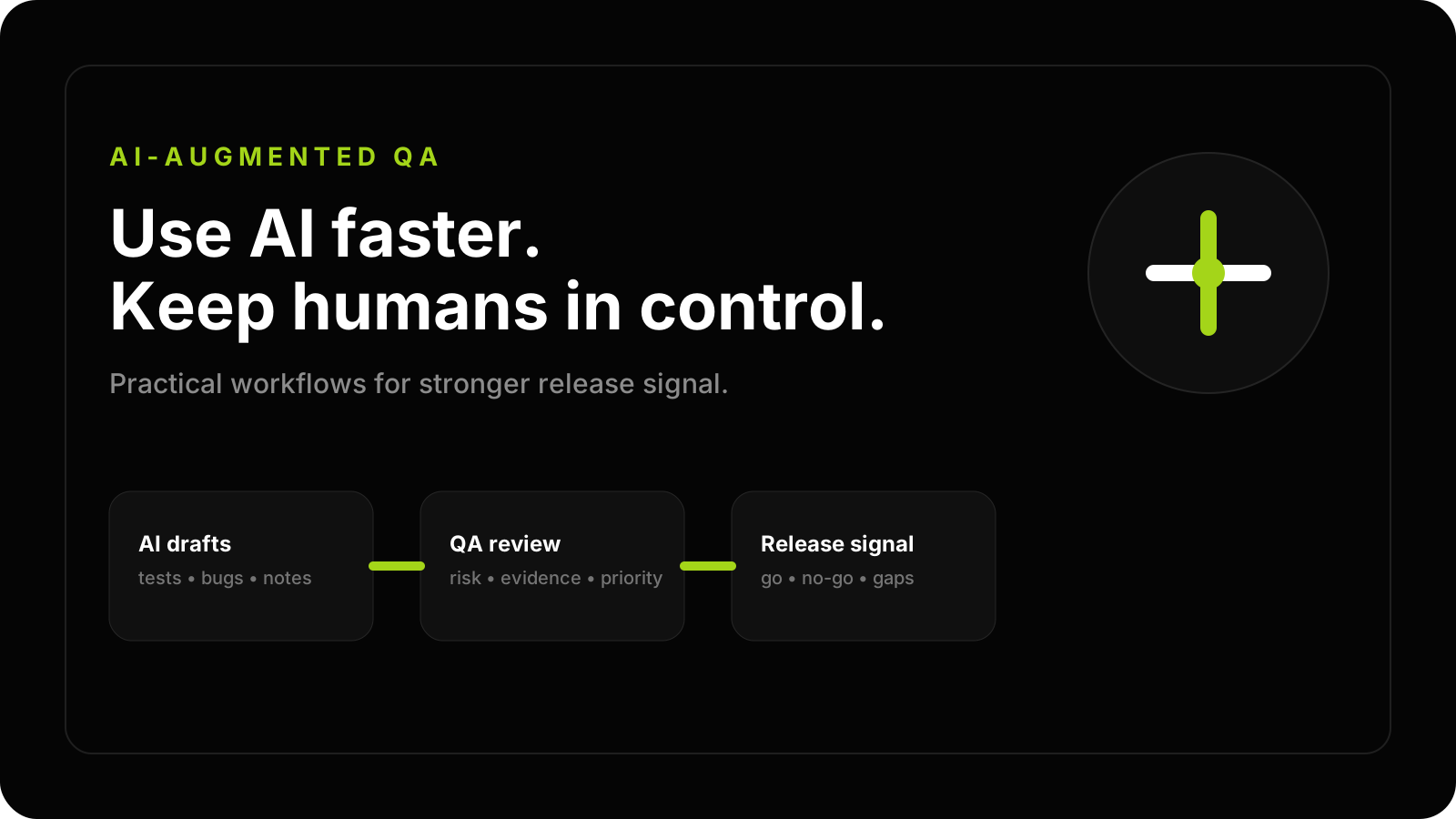
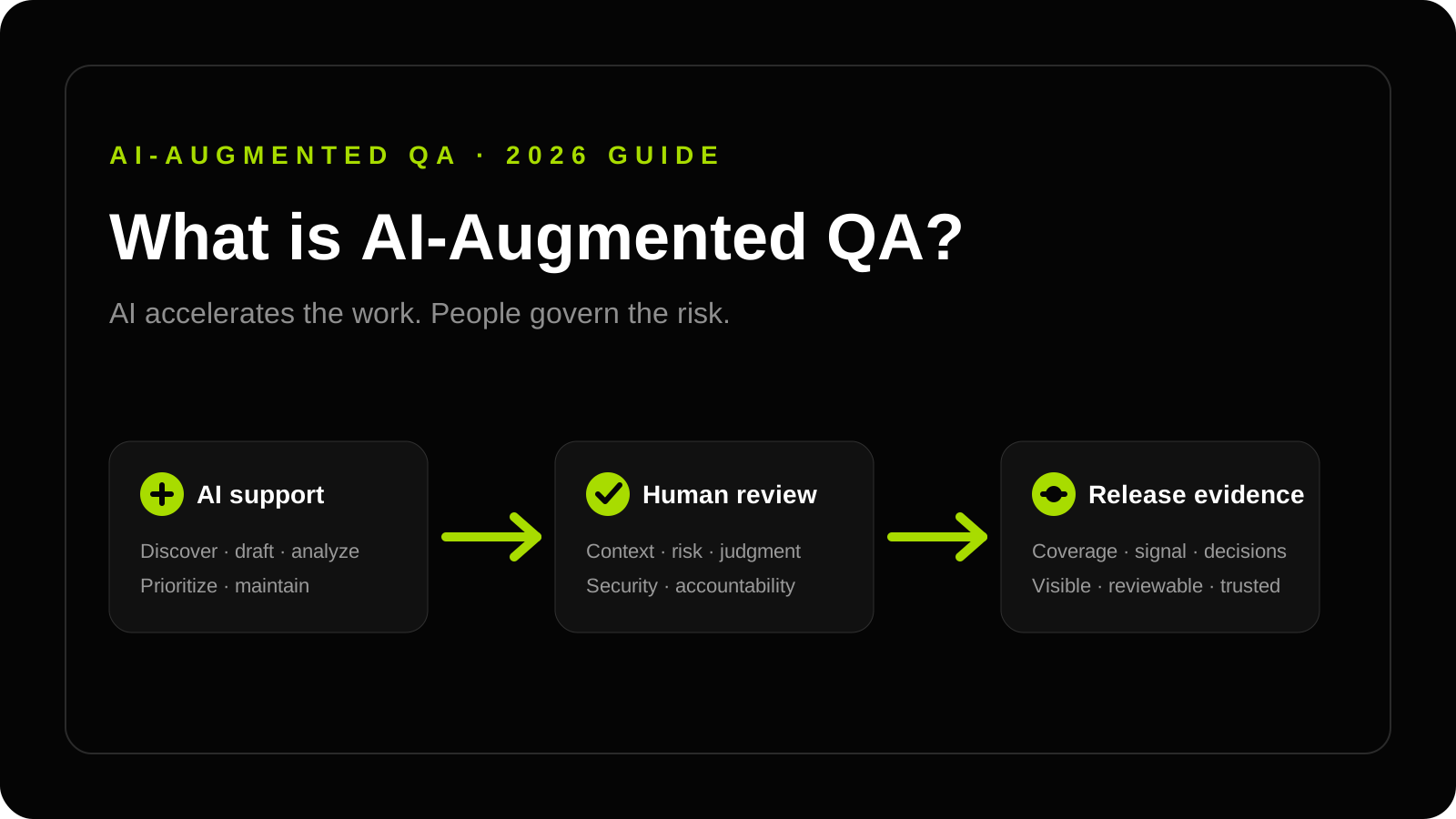
AI-Augmented QA is an approach to quality assurance in which artificial intelligence supports the team throughout the software testing process, while people remain responsible for what should be tested and whether the available evidence is strong enough to support a release. AI can reduce the time spent interpreting requirements, preparing test scenarios, creating initial automation, and reviewing failures, but its value comes from improving the team’s decisions rather than simply producing more tests.
The shift is already underway, although most organizations are still learning how to apply it effectively. According to the World Quality Report 2025–26 by Capgemini, Sogeti, and OpenText, 43% of organizations are experimenting with generative AI in QA, while only 15% have scaled it across the enterprise. This gap shows that experimentation is becoming common, but integrating AI into a reliable quality process remains difficult.
Why AI-Augmented QA Matters in 2026
AI is already becoming part of everyday QA work, often before companies have decided how it should be used. One engineer may use it to draft test cases, another to write automation code, and another to investigate failed test runs. Each use may save time, but when everyone works differently, the team can lose visibility into what was generated, what was reviewed, and what can actually be trusted.
This makes AI-Augmented QA less about introducing another tool and more about creating a consistent way of working. Product teams need to decide where AI adds value, what information can be shared with it, how its output should be checked, and who remains responsible for the final result. Clear roles and human oversight are also central principles in NIST’s guidance for managing AI risk. (NIST AI Resource Center)
The teams that benefit most will not necessarily be those using the most AI tools. They will be the teams that turn scattered individual experiments into a quality process that is repeatable, visible, and trusted across QA, engineering, and product.
The Wrong Way to Think About AI in Software Testing
AI can improve many parts of software testing, but only when teams are clear about the problem they are trying to solve. Most disappointing results come from expecting the technology to replace a sound QA strategy rather than strengthen one.
Treating AI as a Test Case Factory
Generating test cases or automation code can save time, but volume alone does not create better coverage. The output still needs to reflect the product, its users, and the risks the business cannot afford to ignore.
Expecting AI to Run QA on Its Own
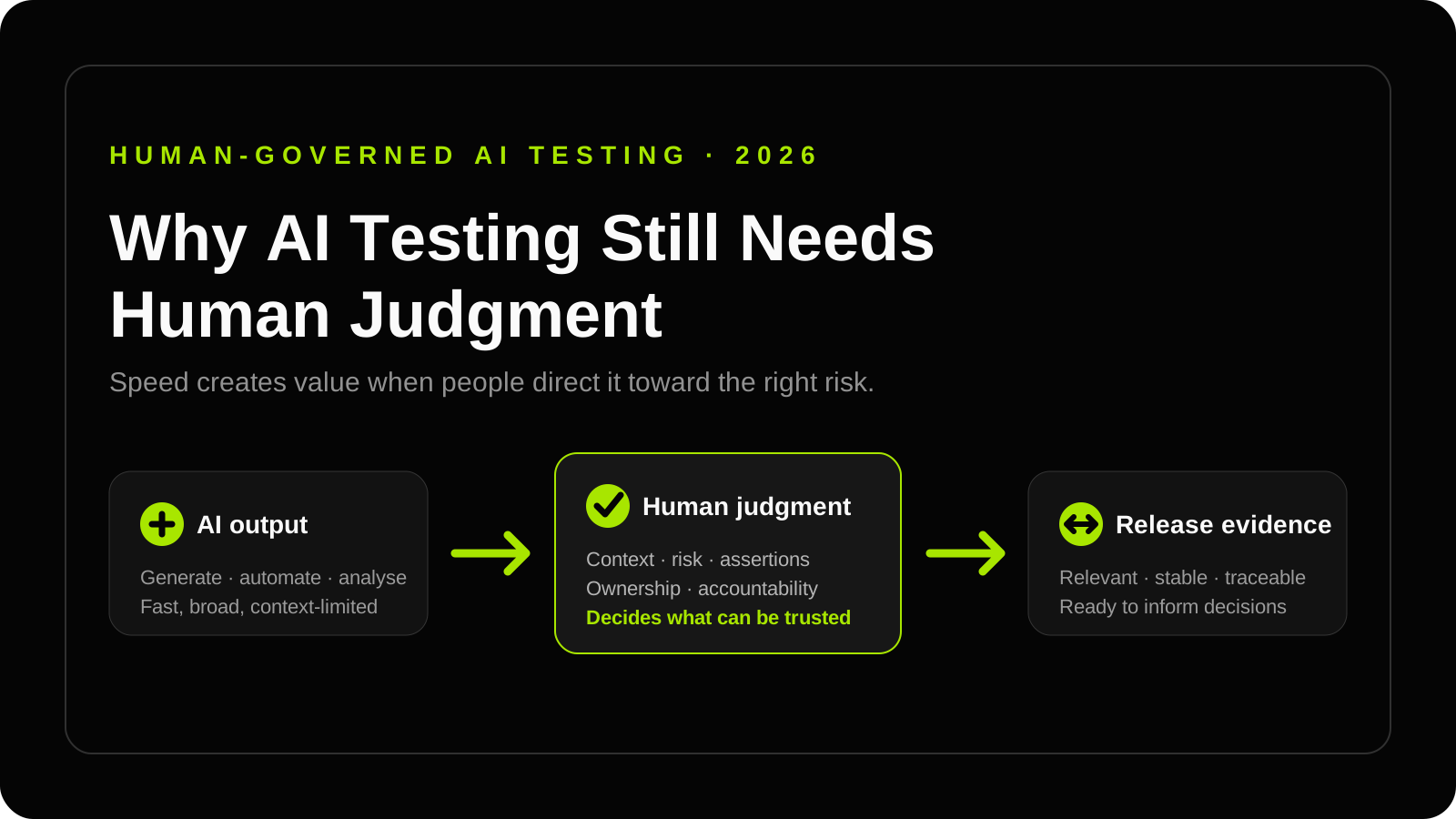
AI can suggest scenarios, analyze failures, and support automation, but it does not fully understand product context or business impact. QA professionals must still review the output and remain responsible for release decisions.
Measuring Success by the Number of Tests
A larger test suite does not automatically make a product safer. Ten tests protecting a critical payment flow may provide more value than hundreds of checks covering low-risk behavior.
Adding AI to a Broken QA Process
AI does not fix unclear requirements, unstable environments, poor automation, or missing ownership. In many cases, it simply creates more output inside a process the team already struggles to trust.
Assuming One AI Tool Can Solve Everything
No single tool can understand every product risk, replace every testing discipline, or make every release decision. AI creates the most value when it supports a clear quality strategy rather than becoming the strategy itself.
AI-Augmented Testing vs Traditional Testing: The Real Trade-Offs
AI-Augmented Testing is not automatically the better option. It works best when it removes a real source of friction, such as slow test design, growing maintenance work, or hours spent investigating failed runs. Traditional testing still has an advantage when the product requires deep exploration, requirements change frequently, or teams need complete control over sensitive data. The comparison below shows what each approach does well, where it can fall short, and which results are worth measuring.
| Decision area | AI-Augmented Testing | Traditional Testing |
|---|---|---|
| Test creation | ✅ Creates an initial set of scenarios from requirements, user stories, or API specifications, reducing the time spent starting from scratch. Human review is still required. | Tests are created manually by people who understand the product, giving the team direct control but requiring more preparation time. |
| Test coverage | ✅ Can suggest edge cases, boundary conditions, and overlooked paths, helping teams explore a wider risk surface. | ⚠️ Coverage depends on what testers have the time and experience to identify. Important gaps may remain unnoticed. |
| Test maintenance | ✅ Can identify likely causes of broken tests and suggest updates when the application changes. | ⚠️ Broken scripts usually need to be investigated and repaired manually, with maintenance growing alongside the test suite. |
| Regression testing | ✅ Can prioritize tests using recent changes, previous failures, and areas of higher risk, giving teams useful feedback sooner. | ➖ Predefined suites are predictable and easy to audit, but full regression becomes slower as more tests are added. |
| Failure analysis | ✅ Can group related failures, summarize logs, and help engineers find a useful starting point for investigation. | Engineers inspect logs and failed tests manually, which provides direct control but can take longer at scale. |
| Human judgment | ⚠️ QA professionals must validate AI output, add product context, and remain responsible for release decisions. | ✅ Human judgment is present throughout the process, although more of the work must be completed manually. |
| Cost profile | ➖ Requires an initial investment in tools, integration, governance, and training, but can reduce repetitive work as adoption matures. | Easier to introduce, although costs can increase as manual testing and automation maintenance grow. |
| Data and compliance | ⚠️ Teams need clear rules for sharing requirements, code, logs, and test data with AI tools. | ✅ Sensitive information is easier to keep within existing systems, access controls, and audit processes. |
| Best suited for | Scale-ups, SaaS companies, ecommerce and fintech products, and established teams with frequent releases, mature CI/CD pipelines, and growing regression suites. | Early-stage startups validating an MVP, small teams building their first QA process, stable products with fewer releases, and companies with strict data-access requirements. |
The advantage of AI-Augmented Testing becomes stronger as testing work grows. It can help the team create coverage faster, reduce maintenance, and reach useful release evidence sooner. Traditional testing remains essential for product understanding, exploration, and judgment, but it becomes more effective when AI handles part of the repetitive work around it. This balance is consistent with current industry framing of AI as a way to increase the effectiveness of QA teams rather than remove them from the process.
The Key Benefits of AI-Augmented QA
AI-Augmented QA creates the most value when it removes measurable friction from the testing process. The goal is not simply to produce more tests, but to help teams work faster, improve coverage, reduce maintenance, and find important defects before they reach production.
Higher QA Productivity
Reported productivity gains from using generative AI in quality engineering average 19%. Much of this improvement comes from reducing repetitive work across requirements analysis, test preparation, failure investigation, and reporting, giving QA engineers more time for complex product risks and exploratory testing.
Faster Test Design and Automation
AI can turn requirements, user stories, or API specifications into an initial set of test scenarios and automation drafts. Instead of starting every task from scratch, QA engineers can review, correct, and strengthen the output. Test-case design and requirements refinement are already among the leading applications of generative AI in quality engineering.
Lower Test Maintenance Effort
AI can help teams understand why automated tests have failed, identify likely changes, and suggest updates to scripts or test data. This reduces the time spent on the first stage of investigation, although every proposed fix still needs human review before it enters a trusted test suite. ISTQB recognizes generative AI support across test analysis, design, implementation, monitoring, and result evaluation.
Broader Test Coverage
AI can help teams explore more scenarios within the same testing window. A controlled 2025 study found that testers using LLM support created 119% more tests, while average branch coverage increased from 16% to 26%. More tests do not automatically mean better quality, but they can give experienced testers a wider set of possible failures to investigate.
Stronger Defect Detection
The same study found that participants using LLM support detected an average of 6.5 defects, compared with 3.7 defects among those testing manually. The AI-supported group also produced more false positives, reinforcing the need for human review before generated tests become part of the regression suite.
The real benefit is the combined effect. Teams can prepare tests faster, spend less time maintaining automation, examine more scenarios, and identify defects earlier. That recovered capacity can then be invested in critical customer journeys, test architecture, and the release risks that still require human judgment.
AI in QA Can Look Right and Still Be Wrong
The benefits are real, but AI introduces a different kind of risk: the output can look complete before anyone has proved that it is correct. The challenge is not only catching obvious mistakes, but recognizing when a plausible answer creates false confidence.
Tests That Pass for the Wrong Reasons
An AI-generated test can run successfully while checking the wrong outcome, overlooking an important business rule, or relying on an assumption that was never part of the requirement. A green result is useful only when the test itself deserves to be trusted.
Hallucinations and Inconsistent Output
AI can invent requirements, endpoints, or expected results and present them as facts. It may also produce different answers from the same context, making its output difficult to reproduce and rely on.
False Confidence Inside the Team
A polished script or convincing failure analysis may receive less scrutiny than it should. Engineers can gradually start trusting AI because it usually sounds right rather than because its work has been verified. NIST treats confabulation, inconsistent output, and excessive reliance on automated systems as connected generative-AI risks.
Adoption Takes More Than a New Tool
AI must fit the team’s repositories, CI/CD pipelines, security policies, and existing QA practices. Engineers also need enough knowledge to challenge weak output, while a gradual rollout makes it easier to see where AI adds value and where it only adds complexity.
Privacy, Security, and Compliance Exposure
Requirements, code, logs, and test data may contain personal or confidential information. Before sharing them with an external AI tool, teams should understand where the data is processed, how long it is retained, and whether its use could affect GDPR, HIPAA, PCI DSS, or SOC 2 requirements. The EDPB confirms that GDPR obligations continue to apply when personal data is used in connection with AI models.
AI can be a powerful partner, but confidence in its output should come from validation, not from how convincing the answer sounds.
How to Integrate AI Into Your Testing Process
Once the benefits and risks are clear, the next step is not to introduce AI across the entire QA function. A better approach is to start with one important problem, test the model through a focused pilot, and expand only after the team can see that it improves the process and produces results worth trusting.
Phase 1: Start With One Critical Product Flow
Choose an area where quality problems have a clear business impact, such as onboarding, checkout, payments, permissions, an API integration, or a data pipeline. Then identify the main source of friction inside that flow: weak coverage, slow regression, unstable automation, or difficult failure analysis.
Phase 2: Establish the Current Baseline
Document how the process performs before introducing AI. Measure the time required to design tests, run regression, maintain automation, and investigate failures. Also record which critical paths are already protected and where the team still depends on manual checks or assumptions.
Phase 3: Run an AI-Augmented QA Pilot
Apply AI to a narrow, measurable part of the selected flow. The pilot may include test discovery, Playwright or API test creation, test-data preparation, regression prioritization, or failure analysis. Keep every output visible and reviewable so weak assumptions are corrected before they become part of the test suite.
Phase 4: Connect It to the Existing QA Stack
Once the workflow proves useful, integrate it with the tools the team already uses. Approved tests should live in the company’s repositories, run through its CI/CD pipelines, and report results through existing engineering workflows. AI should strengthen the current system, not create a separate black box or vendor dependency.
Phase 5: Measure, Standardize, and Expand
Compare the pilot results with the original baseline. Look for faster feedback, lower maintenance effort, stronger critical-flow coverage, and fewer irrelevant tests. Keep the workflows that create measurable value, document how they should be used, and expand them gradually into other product areas.
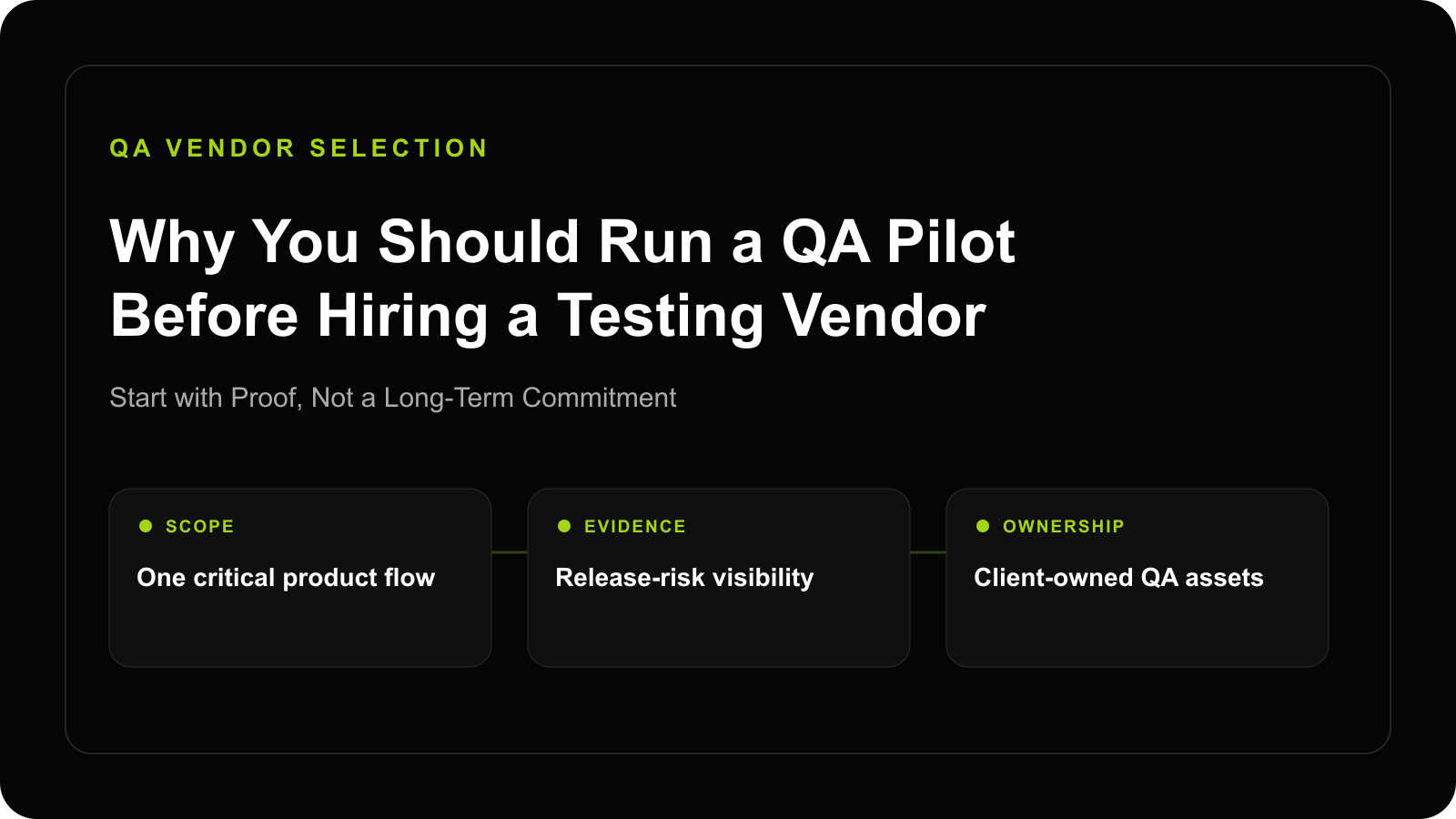
The goal is not to add AI everywhere. It is to prove one reliable workflow and scale from evidence rather than enthusiasm. AQA Masters follows this approach through its 14-Day AI-Augmented QA Pilot, starting with one high-stakes scope, building reviewable workflows inside the client’s existing stack, and leaving the team with client-owned assets and a clear path to continue, expand, or stop.
The Future of Software Testing in the AI Transformation Era
Software testing is moving from isolated AI tools toward connected systems that can support the entire quality process. The biggest change will not be how many tests AI can generate, but how QA teams use AI, automation, and human judgment together.
The Next Chapter for QA Engineers
QA engineers will spend less time creating every test manually and more time defining risk, setting quality standards, and reviewing AI-generated work. Their role will shift from executing tests to coordinating the people, tools, agents, and evidence behind each release.
AI Agents Will Work Across the Testing Lifecycle
AI agents will move beyond single tasks such as writing a test case or summarizing a failure. They will follow product changes across requirements, code, test execution, and production signals, while bringing the most important decisions back to the QA team.
AI Tools Will Become Connected QA Systems
Today, many AI testing tools solve isolated problems, but the next generation will connect test discovery, automation, maintenance, execution, and reporting. Instead of adding another tool to the stack, teams will build AI-supported quality systems that learn from each release.
Human Judgment Will Become More Valuable
As AI produces more tests, recommendations, and technical explanations, teams will need experienced people who can recognize weak assumptions and false confidence. The strongest QA professionals will be those who understand the product, challenge the machine, and know what evidence is strong enough to trust.
Companies That Adapt Now Will Define What Comes Next
AI-Augmented QA is no longer a distant concept that companies can postpone until the technology feels finished. Teams that start now are already learning how to use AI responsibly, redesign testing workflows, and build the skills required to manage AI tools and agents at scale. That experience compounds over time, because AI tends to amplify the quality of the engineering system around it rather than fix weak foundations automatically.
For engineering managers and company leaders, the decision is not whether to replace people with AI or adopt every new tool. The real decision is whether to begin building an AI-ready quality system while there is still time to learn through controlled pilots. Companies that move forward will shape the next standard for software quality, while those that wait risk being left with slower feedback, growing QA debt, and processes designed for a development era that has already moved on.